Guides / For Processors
The shrimp product specification sheet in English: the fields importers expect and what to put in each
November 13, 2026
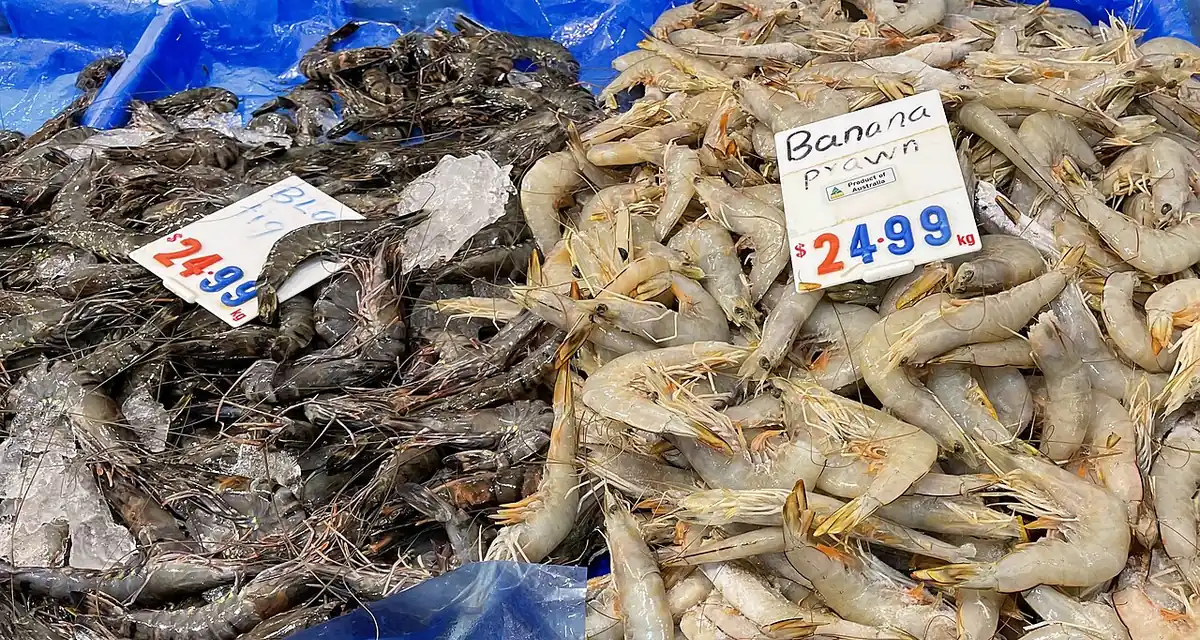
A shrimp product specification sheet is the single page an importer reads to decide whether your product matches a request and then holds you to once a container arrives. A good one lets the buyer compare two plants line by line without writing back for missing fields. This guide lists the fields importers expect, the reference each field draws on and the mistakes that make a sheet useless. The reference throughout is Codex STAN 92-1981, the Codex standard for quick frozen shrimps or prawns. Codex is where most importers start, and the law of the importing country, not Codex, sets the binding limits for the destination.
Why the sheet matters more than the brochure
Our guide on what importers ask Vietnam processors first shows that buyers drop plants on vague answers. A spec sheet is the written form of the specific answer. It also becomes the yardstick in an inspection or a claim: the lot is compared with the sheet, so any field you leave soft is open to dispute. Write only what the plant can deliver every time, and write ranges only where the process really varies.
The fields, in order
| Section | Field | What to write |
|---|---|---|
| Identity | Product name | Plain description, for example “Raw head-off shell-on shrimp, IQF” |
| Species | Latin name, for example Penaeus vannamei or Penaeus monodon, plus the common name | |
| Origin and method | Country, farmed or wild and the farm country if different from the packing country | |
| Form | Processing form | HOSO, HLSO, peeled and deveined, tail-on, butterfly or cooked. See shrimp processing forms |
| Freezing | IQF, semi-IQF or block, as in IQF versus block | |
| Size | Count | Per lb and per kg, on headless deglazed weight, with the tolerance |
| Weight | Glaze | Maximum percent and the deglazing method |
| Net weight | Deglazed kg per inner pack and per master carton | |
| Additives | Processing agents | Name every additive and its use. See soaking agents and sulfite |
| Quality | Sensory | Odor, flavor, color grade. See color grades |
| Defects | The limit for each defect and how it is measured | |
| Safety | Microbiology and chemistry | The limits for the destination market, with a lab report per lot. See residue testing |
| Pack | Packing | Inner pack, master carton size and weight, cartons per pallet and per container |
| Storage | Temperature and shelf life, with the basis for the date | |
| Label | Marking | Name of the food, lot code, name and address, storage instruction |
| Identity | Plant numbers | FDA registration number, HACCP, EU establishment number and certificates only if the plant holds them |
| Control | Version | Date, version, signature, retention sample policy |
Size and count
The count is the field that sets your price, and it is the one most often written loosely. State it per lb and per kg, and say whether the weight is headless, shell-on or peeled. Codex section 7.4 says the count is determined by counting the shrimp in a container or representative sample and dividing by the actual deglazed weight, so a count on a glazed weight is wrong by the glaze. See our size grades guide.
US customs statistics use bands per kilogram of headless weight. The statistical lines under heading 0306.17 of the US tariff schedule read:
| US customs band | Per kg, headless weight | Count per lb, as labeled |
|---|---|---|
| Less than 33 per kg | Under 33 | 15s |
| 33 to 45 per kg | 33 to 45 | 15 to 20 |
| 46 to 55 per kg | 46 to 55 | 21 to 25 |
| 56 to 66 per kg | 56 to 66 | 26 to 30 |
| 67 to 88 per kg | 67 to 88 | 31 to 40 |
| 89 to 110 per kg | 89 to 110 | 41 to 50 |
| 111 to 132 per kg | 111 to 132 | 51 to 60 |
| 133 to 154 per kg | 133 to 154 | 61 to 70 |
| More than 154 per kg | Over 154 | 70s |
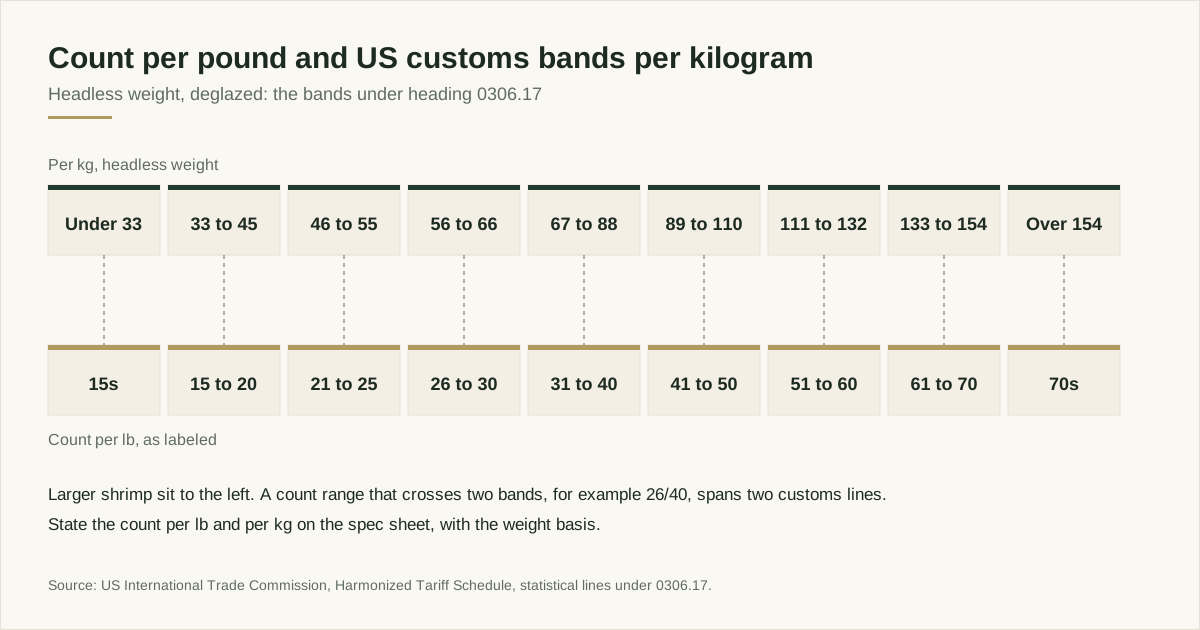
These bands are a statistics scheme, not a quality standard. A count range that crosses two bands, for example 26/40, may make the importer’s entry filing harder, so give a sheet per grade and not one sheet for a mixed range. If a buyer’s order names one of these bands, make sure your count sits inside it.
Glaze and net weight
Codex STAN 92 says the net contents of glazed shrimp are declared exclusive of the glaze (section 6.2). The sheet should say the glaze limit and name the method. Codex 7.3.2 gives one: open the pack straight from cold storage, thaw raw product in fresh water at room temperature introduced from the bottom at about 25 litres a minute, weigh a dry sieve with a 2.8 mm aperture (or the US No. 8 screen at 2.38 mm), drain the shrimp on it inclined at about 20 degrees for 2 minutes, and subtract the sieve weight. Section 9 says a lot meets the standard when the average net weight is not less than the declared weight, with no unreasonable shortage in any one container. The glaze guide shows how these numbers move the price per kilo of shrimp.
Additives and what “no chemicals” means
Codex permits a short additive list for shrimp. It includes citric acid and ascorbic acid at good manufacturing practice, phosphates up to 2,200 mg/kg as phosphorus, and sulfites up to 100 mg/kg in the edible part of raw product or 30 mg/kg in cooked product, expressed as SO2. Importing markets differ from Codex, and the US, EU and Japan each have labeling and limit rules of their own, so check them before you copy a number. The bigger risk is vague wording. “No chemicals” or “additive free” means nothing unless the sheet defines it. Write what is used, and for “none”, write which additive classes the plant does not use and how it checks.
Ready to price this spec? Get matched with a shrimp supplier
Defects, with measurable limits
Codex section 8 defines four defects, and importers use them as a template:
- Deep dehydration: over 10 percent of the shrimp weight or block surface shows moisture loss that masks the flesh color and cannot be scraped off.
- Foreign matter: anything not derived from shrimp that is readily recognized or indicates poor sanitation.
- Odor or flavor: persistent, distinct objectionable odors or flavors from decomposition, rancidity or feed.
- Discoloration: distinct blackening or green or yellow color over more than 10 percent of an individual shrimp’s surface, affecting more than 25 percent of the sample unit.
Section 7.1 sets the sampling at AQL 6.5, with the primary container as the sample unit, or at least 1 kg for IQF. Add the plant’s own defects, such as soft shell and broken shrimp, with the limit and the counting method. Our guide to soft shell, broken and dehydrated shrimp lists them.
Packing, storage and labels
Codex says the quick freezing process is complete when the product reaches -18 C or colder at the thermal center, and the label carries a storage instruction at -18 C or colder. For non-retail containers, the name of the food, the lot identification, the name and address and the storage instructions must always appear on the container, although the lot and address may be replaced by a mark that ties to the accompanying documents (6.4). Name raw or cooked on the label, glazed with seawater if that is the case and the term “quick frozen” or “frozen” as the market uses it. Give carton size, carton weight, cartons per pallet and cartons per container as numbers measured on your own packing line, since the buyer plans freight from them.
A filled example
The values below are for layout only. Replace every value with your plant’s own data and delete any line you cannot support.
| Field | Example entry |
|---|---|
| Product | Raw head-off shell-on shrimp, IQF |
| Species | Penaeus vannamei, farmed |
| Count | 31/40 per lb, 67 to 88 per kg, headless deglazed weight |
| Glaze | 10 percent maximum, method Codex STAN 92 section 7.3.2 |
| Net weight | 1.8 kg deglazed per inner bag |
| Additives | Name each one, or state which classes are not used |
| Storage | -18 C or colder |
| Plant numbers | FDA registration number, HACCP, others only if held |
| Version | Version number, date, signature |
Mistakes that make a sheet useless
- A count with no weight basis or with a range that spans two bands.
- Glaze without a method, or “about 10 percent”.
- Additive wording that is a slogan and not a list.
- Certificate photos in place of numbers and validity dates.
- Limits copied from a brochure or another country’s rule without checking the destination.
- No date or version, so no one knows which sheet a quote used.
Send the sheet with the first sample, and let the buyer test the sample against it: our buyer-side guide to frozen shrimp samples shows what an importer measures, and a pre-shipment inspection will use the same fields.
Next step
Write one sheet per grade and form, then register your plant with the grades and numbers you actually hold. We pass buyer requests to registered plants that match the spec, and buyers read the sheet before they quote or ask for a sample. Keep it current, and update the version when the process changes.
See also: frozen shrimp product forms, from HOSO to cooked.
Sources
- Codex Alimentarius, CODEX STAN 92-1981, standard for quick frozen shrimps or prawns
- US International Trade Commission, Harmonized Tariff Schedule, heading 0306.17, statistical count-size lines
Frequently asked questions
What should a shrimp product specification sheet contain?
At minimum: species with the Latin name, processing form, count with its weight basis, glaze and the deglazing method, net weight per pack and carton, additives, defect limits, packing and storage, labeling and the plant's registration and certificate numbers. Date it and number the version, so the importer knows which sheet a quote refers to.
Which standard do importers use as the reference for frozen shrimp?
Most start from Codex STAN 92-1981, the Codex standard for quick frozen shrimps or prawns. It defines the product, the glaze and net weight method, the additive limits, the labeling and the defects. It is a reference, and the law of the importing country sets the binding limits, so the sheet should also name the destination market.
Should the sheet state count per pound or per kilogram?
State both, with the basis. Importers in the US talk in counts per pound such as 31/40, while US customs statistics use bands per kilogram of headless weight, where 31/40 falls in 67 to 88 per kg. Codex says count is worked out on the deglazed weight, so write that the count is on deglazed headless weight.
What defects does Codex define for frozen shrimp?
Four: deep dehydration over 10 percent of the weight or block surface, foreign matter, persistent objectionable odor or flavor and discoloration. Discoloration means distinct blackening or green or yellow color over more than 10 percent of an individual shrimp's surface, affecting more than 25 percent of the sample unit.
Ready to price this spec?
Send your species, size grade and certificate list. We match you with up to 3 Vietnam processors and reply within 24 business hours.
Get matched with a shrimp supplier