Guides / For Processors
How to build a frozen shrimp FOB price, and what changes when the importer asks for CFR
November 15, 2026
A frozen shrimp FOB price is the cost of getting one kilogram of finished shrimp to the point where it sits on board a vessel at a Vietnamese port, plus the margin the plant needs. Most quote disputes do not start with the margin. They start with the unit, the weight basis or the term, because the importer and the plant priced two different things. This guide builds an FOB price line by line, shows how the same shrimp looks at different glaze levels, and explains what changes when the importer asks for CFR. It uses assumed numbers for the arithmetic. No public source publishes a processor’s conversion cost or an FOB price series for Vietnam shrimp, so every figure in the worked example is a placeholder to replace with your own.
Start with the unit the buyer will compare
Codex STAN 92, the standard for quick frozen shrimps or prawns, sets two rules that decide the unit. Where the food is glazed, the declaration of net contents is exclusive of the glaze (section 6.2), and the count is worked out by dividing the number of shrimp by the actual deglazed weight (section 7.4). So the comparable unit is one kilogram of shrimp with the glaze removed. Build your cost on that unit, then state how it converts to the glazed weight on the carton. Our guide to glaze, net weight and yield in quotes shows the same logic from the buyer’s side.
The build, line by line
| Line | How to get it | Common mistake |
|---|---|---|
| Raw material per kg of raw shrimp | Your own purchase price for that size on the day of quote. Farm-gate prices by count are published in the trade press, as in our guide to the Vietnam shrimp price in 2026 | Using last month’s price in a market that moves inside a season |
| Yield, raw to finished | Your own measured yield for that size and form. Divide the raw price by the yield to get raw cost per finished kilogram | Copying a table. Yield moves with size, form and line |
| Labor and utilities | Cost per finished kilogram from the plant’s own records | Costing HLSO and peeled product at the same rate |
| Packing | Inner bag, master carton, strapping, labels, pallet | Forgetting private label printing or a change of carton size |
| Freezing and cold storage | Days in store before loading, at the plant’s tariff | Ignoring storage for orders that wait on a vessel |
| Quality control | Lab tests, inspection fees, certificate costs | Treating lab work as overhead and not as a per-lot cost |
| Port side costs | Haulage to the port, terminal handling at the loading port, export clearance, documents | Quoting FOB with a destination port named, which mixes two terms |
| Money cost | Interest on the deposit gap, bank charges, exchange risk | Leaving it out when the payment terms are 30 percent in advance and the rest on a copy of the bill of lading |
| Margin and price-move allowance | What the plant needs, plus cover for raw shrimp moving before the order is confirmed | Keeping the quote open for weeks |
Raw cost per finished kilogram is the largest line, so the yield figure carries the quote. Yield by form and size is a measurement, not a table lookup. Our guide to shrimp processing forms shows how much each step removes.
A worked example with assumed numbers
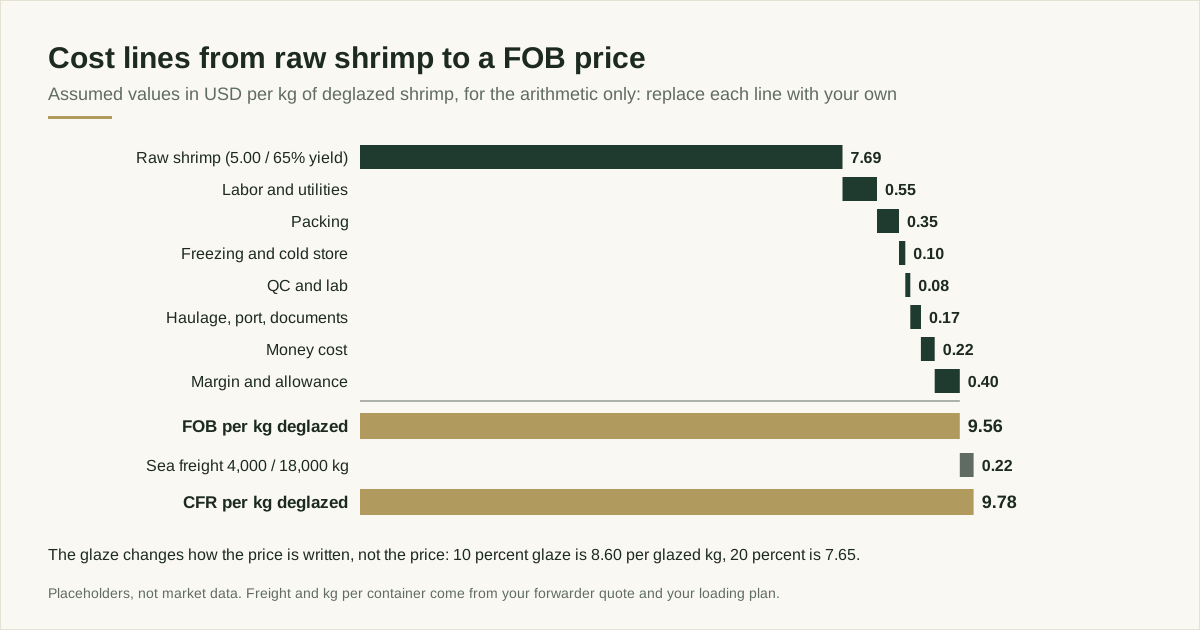
The numbers below are round placeholders for the arithmetic, not market data. The raw price is set near the June 2026 farm-gate level for 25 count reported in our price guide. The yield is inside the 62 to 68 percent range our glaze guide gives for HLSO. Replace every line with your own.
| Line | Assumed value, USD per kg of deglazed finished shrimp |
|---|---|
| Raw shrimp: 5.00 per kg raw, divided by 65 percent yield | 7.69 |
| Labor and utilities | 0.55 |
| Packing | 0.35 |
| Freezing and cold storage | 0.10 |
| Quality control and lab | 0.08 |
| Haulage, port handling, export documents | 0.17 |
| Money cost | 0.22 |
| Margin and price-move allowance | 0.40 |
| FOB price per kg of deglazed shrimp | 9.56 |
The glaze changes only how that same price is written. If the carton is glazed and the quote is per kilogram of glazed weight, the price per glazed kilogram is the deglazed price multiplied by one minus the glaze fraction:
| Glaze, percent of glazed weight | Price per glazed kg | Price per deglazed kg |
|---|---|---|
| 10 | 8.60 | 9.56 |
| 20 | 7.65 | 9.56 |
The 20 percent offer looks 11 percent cheaper and is the same money per kilogram of shrimp. A buyer who compares the two glazed prices without converting will either pick the wrong plant or come back to you with a conversion. If you quote on the net deglazed basis and state the glaze, you take that argument off the table. For glaze that is higher than the buyer expects, say how the plant measures it. Codex 7.3.2 gives a method for raw product: melt the glaze in fresh water at room temperature, drain the shrimp for 2 minutes on a sieve with a 2.8 mm aperture inclined at about 20 degrees, and weigh the drained shrimp less the sieve.
What changes under CFR
CFR means cost and freight to a named destination port. According to the ICC Academy, the seller under CFR books and pays the vessel and freight, delivers the goods on board at the port of shipment, clears them for export and bears costs and risk until then. The same source states three points that matter for the quote:
- The risk still passes at loading. Risk moves to the buyer once the goods are on board at the port of shipment, even if they arrive damaged or not at all. The ICC says CFR does not mean the seller brings the goods to the destination.
- No duty to insure. CFR does not require the seller to buy cargo insurance. The buyer should arrange its own.
- The buyer pays import costs. Import clearance, duties and taxes at the destination are the buyer’s.
The U.S. International Trade Administration’s guide says the same about scope: FOB names the port of loading and CFR the port of destination, and the rules do not settle the price, the payment method, the transfer of title or liability for non-conforming goods. Those go in your sales contract.
To turn the FOB build into a CFR price, add the freight per kilogram:
| Item | Assumed value |
|---|---|
| Sea freight quote for one reefer container to the destination port | 4,000 USD |
| Net deglazed shrimp per container, from your loading plan | 18,000 kg |
| Freight per kg | 0.22 USD |
| CFR price per kg of deglazed shrimp | 9.78 USD |
Those two inputs are placeholders. Get the freight as an all-in figure from your forwarder, including the reefer surcharges, and write the date it is valid until. A CFR seller who quotes with an old freight rate carries the difference when the rate rises before booking. Our guide to reefer loading lists the cold-chain details the forwarder should confirm.
Ready to price this spec? Get matched with a shrimp supplier
Which term to offer
| Term | Who books the sea freight | Risk passes | Insurance |
|---|---|---|---|
| FOB | Buyer | On board at the port of shipment | Not required of either party |
| CFR | Seller, to the destination port | On board at the port of shipment | Not required of the seller |
| FCA | Buyer | When goods are handed to the buyer’s carrier at the named place | Not required of either party |
ICC commentary says FAS, FOB, CFR and CIF are the old port to port rules and are not suitable for container shipments in their present form, because a container is often stacked at the terminal long before it is loaded and that moment is out of the seller’s hands. It points to FCA for containers, and to CPT or CIP where the seller pays the carriage. The importer’s request may still say FOB or CFR. You do not have to refuse it, but know where your responsibility ends in practice, and name the exact port and place in the quote. The choice also affects payment papers, so settle it before the contract. Our guide to payment terms and the first order timeline covers the documents that follow.
A quote that cannot be misread
State these in every quote:
- Product form, species and count on deglazed weight, per pound and per kilogram.
- Price per kilogram of net weight, glaze excluded, with the glaze percentage and how it is measured.
- Pack: inner bag, master carton, net weight per carton, cartons per container from your loading plan.
- Term and the named port: for example FOB with the Vietnamese port of loading, never FOB with a US port.
- Currency, payment terms and the validity date of the price.
- Production and shipping window, counted from deposit or from the letter of credit.
- What the price leaves out: freight, insurance, destination duty and the anti-dumping cash deposit, which the importer pays at entry.
Mistakes that cost margin
- Pricing on glazed weight without saying so, then conceding a discount when the buyer converts.
- A raw price from last month. If the market moves inside a season, shorten the validity.
- A fixed CFR price on a freight rate that is not locked.
- A yield taken from another plant or a textbook range.
- Leaving the money cost out when the payment terms leave you carrying the raw material.
Buyers read the same quote through our guide to the Vietnam shrimp export price.
After the price comes the buyer’s first questions to a Vietnam processor, and the quote is where those answers meet the spec. If you want requests that fit your grades and terms, register as a processor. We pass buyer requests to registered plants whose spec matches, and the plant and the buyer agree the price between themselves.
Sources
- Codex Alimentarius, CODEX STAN 92-1981, standard for quick frozen shrimps or prawns
- ICC Academy, CFR and CIF Incoterms 2020 explained
- ICC Academy, Incoterms 2020: CFR vs FOB and the title transfer myth
- US International Trade Administration, Know your Incoterms
Frequently asked questions
What does an FOB price include for frozen shrimp?
The shrimp, the packing, the cold chain to the port, export clearance and loading on board the vessel at the named port of shipment. Ocean freight, cargo insurance, import duty, anti-dumping deposits, brokerage and delivery at the destination are for the buyer. Write the named loading port in the quote, since FOB without a port is not a complete term.
What is the difference between a FOB and a CFR shrimp quote?
Under FOB the buyer books and pays the sea freight. Under CFR the seller books and pays the freight to a named destination port. In both terms the risk passes to the buyer once the goods are on board at the port of shipment, so a CFR seller pays the freight but does not carry the risk of the voyage. CFR also does not oblige the seller to insure.
Should I quote frozen shrimp per kilogram of glazed or deglazed weight?
Quote per kilogram of net weight, glaze excluded, and state the glaze percentage. Codex STAN 92 says the declaration of net contents of glazed shrimp is exclusive of the glaze, and counts are worked out on deglazed weight. A price on glazed weight looks lower than it is, and the buyer will convert it anyway.
Is FOB the right Incoterm for a container of frozen shrimp?
ICC commentary says FOB, CFR and CIF were written for port to port bulk or break-bulk cargo and fit containers poorly, because a box is often stacked at the terminal long before it is loaded. It points to FCA, CPT or CIP for containers. Many requests still name FOB or CFR, so know what you are agreeing and ask for the named port.
Ready to price this spec?
Send your species, size grade and certificate list. We match you with up to 3 Vietnam processors and reply within 24 business hours.
Get matched with a shrimp supplier