Home / Product forms
Frozen shrimp product forms, from HOSO to cooked
A shrimp product form says which parts of the animal are still on the frozen piece: the head, the shell, the vein and the tail. Nine forms cover almost all export trade, from HOSO (nothing removed) to cooked PD (head, shell and vein removed, then cooked). Each step takes weight off the piece and adds labour, so the form moves the yield, the count and the price as much as the size grade does.
| Form | Head | Shell | Vein | Tail | Typical yield from HOSO | Count unit | Main markets |
|---|---|---|---|---|---|---|---|
| HOSO, head on shell on | On | On | In | On | 100 percent | Per kg | China, Korea, EU wholesale, Asian retail |
| HLSO, headless shell on | Off | On | In | On | 62 to 68 percent | Per lb | US, Japan (black tiger blocks), EU |
| EZ peel | Off | On, cut along the back | Out | On | 60 to 66 percent | Per lb | US retail and foodservice |
| PUD, peeled undeveined | Off | Off | In | Off | 52 to 58 percent | Per lb | Further processing, small counts, Asia |
| PD, peeled and deveined | Off | Off | Out | Off | 50 to 56 percent | Per lb | US and EU retail, foodservice |
| PDTO, peeled deveined tail on | Off | Off except last segment | Out | On | 52 to 58 percent | Per lb | Foodservice, cocktail rings, skewers |
| Butterfly | Off | Off except last segment | Out, deep cut | On | 50 to 56 percent | Per lb | Breaded, tempura, restaurant plating |
| Nobashi | Off | Off except last segment | Out | On | 50 to 56 percent | Pieces per tray, by length | Japan tempura and ebi fry |
| Cooked (CHOSO, CPD, CPDTO) | As the raw form | As the raw form | As the raw form | As the raw form | 42 to 50 percent for cooked PD | Per lb, counted after cooking | US and EU retail, salads, sushi |
Yield figures are typical working ranges, not constants. They move with species, size, moult stage, season and how a plant sets its peeling and deveining line.
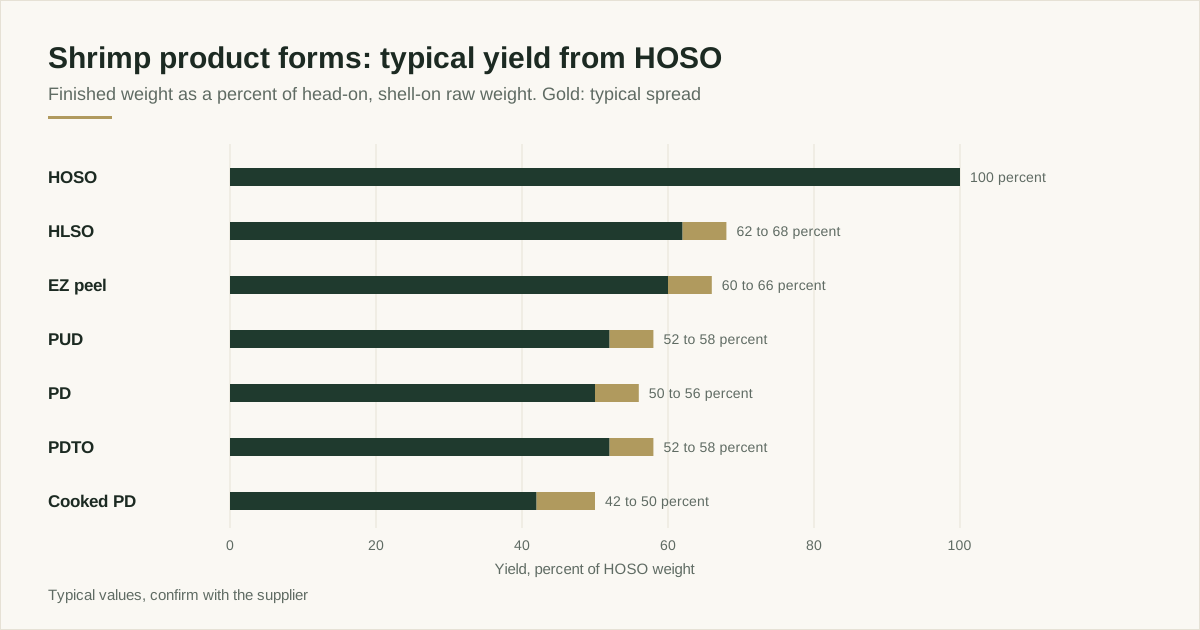
How the forms relate
Read the table as a tree, not a list. HOSO is the raw material for everything. HLSO is the first branch: once the head is off, the shrimp goes either to shell-on forms (HLSO, EZ peel) or to peeled forms. Peeled forms split again by vein (PUD or PD) and by tail (PD or PDTO). Butterfly and nobashi are PDTO with an extra cut or stretch. Cooked forms are any of the above put through a cooker and chiller.
Three consequences matter in a purchase.
The count belongs to the form in the carton. A PD 26/30 is 26 to 30 peeled pieces per pound, not peeled from HLSO 26/30. Raw HLSO 21/25 typically ends up near 26/30 once peeled. The count chart has the full conversion by form.
Every form after HLSO is labour. Peeling, deveining, tail work, cutting and stretching are mostly done by hand on Vietnamese lines, often with machine assistance for peeling small counts. Labour is priced into the form, not the species.
Cooked forms carry their own controls. A cooked line needs a validated cook step, a chiller and a separation between raw and cooked areas. Not every plant that packs good raw PD runs cooked product daily.
Shell-on forms
HOSO: head on, shell on
The whole animal, frozen. HOSO is graded per kilogram, commonly in bands such as 30/40, 40/50 and 60/70 pieces per kg. It is packed as frozen blocks (often 6 x 2 kg in a carton) or IQF. The head carries the digestive gland, so HOSO shows quality faults first: black or loose heads, head drop and melanosis. Buyers in China, Korea, Spain and Asian wholesale use HOSO because the head is part of the dish and a whole animal shows freshness.
HLSO: headless, shell on
The head is removed by hand at the plant, usually by twisting it off at the carapace joint. HLSO keeps the shell, so the meat is protected in storage and thaws without drying. It is the trade baseline: black tiger HLSO blocks for Japan and vannamei HLSO for US and EU repackers. A clean head removal leaves no hanging membrane or dark digestive matter on the first segment. Shell integrity, meaning no broken or missing shell segments, is the main HLSO quality line.
EZ peel: shell on, cut and deveined
HLSO with a cut along the back through the shell, and the vein removed through that cut. The shell stays on through cooking and the consumer slips it off. It is a US retail and foodservice format, sold raw for boiling and grilling. The cut depth is set by the buyer: shallow enough that the piece stays whole, deep enough that the vein comes out cleanly.
Peeled forms
PUD: peeled, undeveined
All shell segments and the tail removed, vein left in. PUD is mostly small counts (71/90 and smaller), used in fried rice, dumplings, soups and further processing, where deveining each piece costs more than it is worth. Some buyers accept a pulled vein, removed through the head end without a cut, and still call it PUD. Write “vein in” or “vein pulled” to avoid the argument.
PD: peeled and deveined, tail off
Fully peeled, tail removed, vein out through a shallow cut along the back. PD is the standard retail bag and salad form. The wording varies: PD, P&D, PND and “peeled and deveined tail off” mean the same thing in most offers, but some buyers use P&D for both tail-on and tail-off. Always add “tail off”. The quality lines are vein residue (a share of pieces with vein left), broken pieces and a clean cut that does not split the piece.
PDTO: peeled, deveined, tail on
Peeled except for the last shell segment and the tail fan, deveined. PDTO is the presentation form for cocktail rings, skewers, grilling and plated foodservice. The tail gives the diner a handle and makes the piece look larger on the plate. See the PDTO specification for the tail and segment rule.
Cut and stretched forms
Butterfly
PDTO with a deep cut along the back so the piece opens flat. Butterfly is the base for breaded and tempura products and for restaurant dishes where the shrimp should lie flat and cook evenly. Some programmes specify “western style”, a butterfly cut through most of the thickness, and others “round”, a shallow cut that keeps the piece curled. For coated products see breaded and tempura shrimp.
Nobashi
PDTO that has been cut on the underside and pressed to straighten it, so it fries straight for tempura and ebi fry. Nobashi is sold by length and pieces per tray rather than by a per pound count, and is almost entirely a Japan business. The detailed process is in how nobashi shrimp is made. Sushi ebi, a cooked and butterflied shrimp, is a separate product, see sushi ebi specs.
Cooked forms
Any raw form can be cooked. The common ones are cooked HOSO (for Spain and Asian retail), CPD (cooked, peeled, deveined, tail off) and CPDTO or CPTO (cooked, peeled, tail on, the cocktail form). Three lines differ from raw specs:
| Spec line | Raw form | Cooked form |
|---|---|---|
| Count | Counted raw | Counted after cooking, so the raw input is a larger grade |
| Yield | From HOSO or HLSO | Cook yield from raw input, typically 80 to 90 percent for unsoaked PD |
| Food safety | Raw for cooking | Ready to eat: pathogen controls, often Listeria testing set by the buyer |
| Colour | Raw colour score | Cooked colour score after the cook step |
The cook step and its controls are covered in cooked shrimp processing.
Freezing and treatment are separate fields
Product form says what is on the piece. It does not say how it was frozen or treated. Any form can come as IQF (pieces frozen separately), semi-IQF or block, and any form can be untreated, phosphate treated or treated with a non-phosphate agent. These are separate lines in a spec. See IQF, semi-IQF and block frozen shrimp.
Writing the form in a request
Write species, form, tail, vein, count and freezing together, in that order: “vannamei PDTO, tail on, deveined by back cut, 21/25 per lb, IQF”. Add glaze and pack, see the count chart for the weight basis. The older processing forms guide covers value-add lines built on these forms.
Send the line through the request form and we match it with Vietnamese processors that run that form.
Frequently asked questions
What are the main shrimp product forms?
From least to most processed: HOSO (head on, shell on), HLSO (headless, shell on), EZ peel (shell cut and deveined but left on), PUD (peeled, undeveined), PD (peeled and deveined, tail off), PDTO (peeled, deveined, tail on), butterfly, nobashi and the cooked versions of these. Breaded, marinated and skewered products are value-add lines built on one of them.
Is P&D the same as PD?
Usually yes: both mean peeled and deveined. Some buyers use P&D for tail-off product and PDTO for tail-on. Because the wording is not standardised, write tail on or tail off next to the abbreviation every time.
What is the difference between PUD and PD shrimp?
Both are fully peeled. PUD keeps the vein, PD has it removed, usually with a shallow cut along the back. PUD is common in small counts where deveining each piece costs more than the buyer will pay.
How much yield is lost from HOSO to PD?
Typically about half. HLSO keeps about 62 to 68 percent of the head-on weight and PD about 50 to 56 percent. The figure moves with species, size, season and the plant's line, so ask the processor for its own yield on your count.
Which product form should a first order use?
The form your own customer buys, with no extra steps. If you sell PD in retail bags, buy PD rather than HLSO to peel locally, unless you have a peeling line and the labour cost works out.
Sources
- Codex Alimentarius, Standard for Quick Frozen Shrimps or Prawns (CXS 92-1981)
- Codex Alimentarius, Code of Practice for Fish and Fishery Products (CXC 52-2003)
Last reviewed 18 October 2026
Ready to price this spec?
Send your species, size grade and certificate list. We match you with up to 3 Vietnam processors and reply within 24 business hours.
Get matched with a shrimp supplier