Guides / Certification
Antibiotic residue testing for shrimp: what the EU and US check and what to ask a plant
October 19, 2026
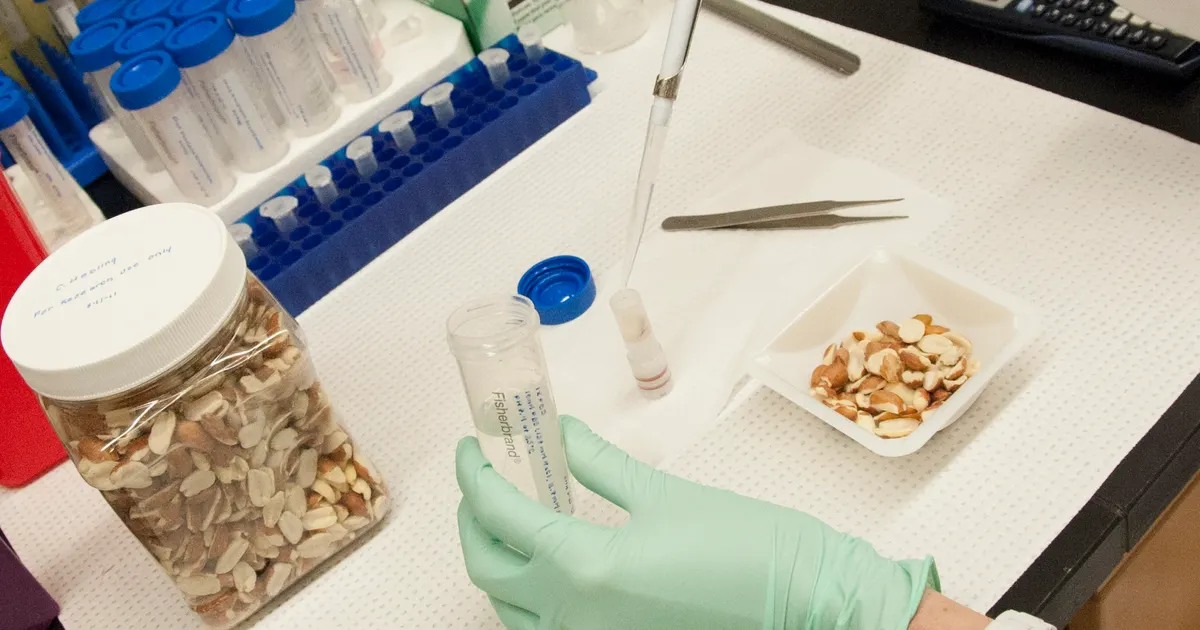
A shrimp container can leave Vietnam in perfect condition and still be held at a border because a laboratory found a banned residue in a sample. The cost lands on the importer: storage, re-testing, destruction or return, and a customer with an empty shelf. Residue testing is therefore not a paperwork step. It is the control that decides whether a Vietnam shipment reaches the buyer.
This guide explains what the EU and the US look for, how a plant builds a testing programme and which records to ask for before you place an order.
Why antibiotic residues matter in farmed shrimp
Farmed shrimp can be treated with veterinary products during grow-out, and some past practices left residues in the meat. Several substances are banned in food-producing animals in the EU, the US and other major markets because of safety concerns, and the rule applies regardless of how little remains. Import authorities test shrimp at the border with sensitive methods, and a positive result leads to detention or rejection of the lot.
Residue control starts on the farm, long before the plant. Farmers choose what to put in the pond, hatcheries supply post-larvae, and feed mills and input suppliers can add risk through contaminated products. A plant that tests only at the end of the line finds problems late. The strongest plants combine farm-level controls with intake testing and finished product testing.
What the EU and the US look for
Each market publishes its own lists and limits, and the details change. The pattern is similar.
| Market | Typical focus of border checks | How the check works |
|---|---|---|
| EU | Banned substances such as chloramphenicol and nitrofuran metabolites, malachite green and its metabolite, other unauthorised substances | Official sampling of consignments at border inspection posts at a set frequency, higher for origins with past findings |
| United States | Unapproved drugs in aquaculture products, including nitrofurans, chloramphenicol, fluoroquinolones and certain dyes | FDA sampling and import alerts that can detain shipments from firms with prior violations |
| Japan | Residues under the positive list system with uniform limits for unlisted substances | Importer and port checks, with extra monitoring for some origins |
| Korea and Australia | National residue lists and port sampling | Import inspection by the national authority |
Check the current official list for your market. Limits and reference points are updated, and a new analytical method can detect lower levels than before.
Two things follow for a buyer. First, past findings matter: an origin or a firm with earlier detections faces more frequent checks, which means more delay risk. Second, a negative result at the plant reduces risk but cannot guarantee clearance, because the border laboratory uses its own sample and method.
How a plant tests shrimp lots
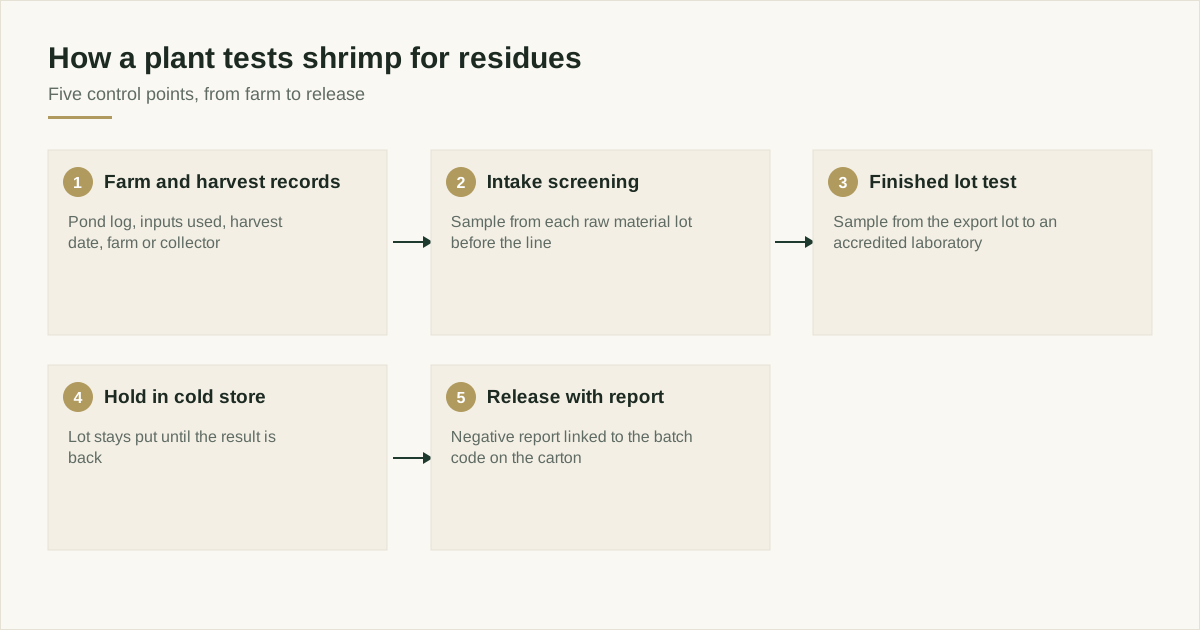
A plant that exports to the EU and US normally runs a structured programme with several layers.
- Farm and harvest records. The plant asks for the pond log, the inputs used and the harvest date, and it links each purchase to a farm or collector.
- Intake sampling. A small sample from each raw material lot goes for screening before the shrimp enter the line, so a doubtful lot can be separated.
- Finished product testing. A sample from each export lot, or a defined share of lots, goes to a laboratory that tests with liquid chromatography and mass spectrometry for the banned substances in the target market.
- Accredited laboratory. The laboratory should hold accreditation to the standard for testing laboratories, ISO/IEC 17025, for the methods in use. Ask for the scope of accreditation and the method name on the report.
- Hold and release. The lot stays in the cold store until the result is back, and release depends on a negative report.
Some plants add a second sample in the importing country, either from a retained sample sent by courier or from a split sample at arrival. This costs more but gives the buyer an independent check.
What a good residue report shows
A residue report is useful only if it can be traced to the carton. A complete report should show:
- The laboratory name and address, and the accreditation scope.
- The sample ID, the lot or batch code, the production date and the product description.
- The list of analytes tested and the method used for each.
- The result and the limit of detection or quantification for each analyte.
- The test date and the signature of the person who released the report.
Reports without a batch code or without the list of analytes tested leave gaps. Ask the plant to explain how it links the report number to the carton marking, and check the link on your first shipment.
Records to ask for before an order
Residue control depends on documents as much as on tests. Request this set before the first order and keep it in the supplier file.
- The plant’s residue monitoring plan for the destination market.
- The last six months of test results, with the analytes and the share of lots tested.
- The farm traceability procedure and a sample record from a recent lot.
- A list of approved farms or collectors, with the criteria for approval.
- The corrective action procedure after a positive result.
- The product specification sheet that states the residue limits the plant works to.
Certificates belong to the plant and the auditors who verify them, and a buyer should check each one with the issuer. Our guide on certifications by export market lists the schemes the main markets expect and the documents that go with the shipment. Traceability from pond to plant, which supports the whole residue system, is covered in shrimp traceability in the Mekong Delta.
Ready to price this spec? Get matched with a shrimp supplier
What happens at the border when a sample fails
When a border laboratory reports a banned substance, the authority acts on the lot. In the EU the consignment is usually blocked at the border inspection post and the finding enters the rapid alert system that links member states. The consignment is then re-exported or destroyed, and the importer bears the cost unless the contract says otherwise. In the US, FDA can detain the shipment at the port and refuse admission, and it can place the firm on an import alert, which brings automatic detention of later shipments until the firm shows it has fixed the cause.
A single positive can therefore delay more than one container. Shipments already at sea may reach a border where the origin or firm now faces tighter checks. Buyers who track alerts for their origin and their plant can reduce surprises. Both authorities publish their alerts, and your customs broker can monitor them for you.
Why one plant’s record matters more than the origin’s record
Border statistics often group results by country, but the risk sits at the level of the farm and the plant. Two plants in the same province can run very different residue systems. One buys from a small group of registered farms with pond logs and intake testing, and the other buys from many collectors with no record. A buyer who looks only at the national picture misses this difference.
Ask the plant for its own history: how many lots it exported to your market in the last year, how many were tested, and whether any border finding occurred. A plant with a clean history and a transparent programme is worth more than a lower price from a plant that cannot answer.
Contract terms that protect the buyer
A clear contract reduces the cost of a failure. Consider these terms.
- Specification of limits. Name the substances and the limits in the contract, and state that the plant works to the destination market’s rules.
- Lot testing. Require a report for each lot before loading, with the batch code on the report.
- Retained samples. Require the plant to keep a frozen retained sample from each lot for a set period.
- Border failure. Define who pays for storage, re-testing, destruction or return if a border laboratory reports a violation, and under what conditions.
- Corrective action. Require the plant to investigate a positive result, report the cause and stop supply from the farms involved.
Payment terms interact with these clauses. Our guide on payment terms and the first order timeline explains how deposits, balance payments and documents fit together, and why a balance held until the residue report arrives protects both sides.
Early warning signs in a supplier
Some patterns suggest a weak residue system.
- The plant cannot link a test report to a lot or a carton.
- The plant tests only a small share of lots and cannot say how it picks them.
- Laboratory reports come from a lab without a stated accreditation scope.
- The plant buys from many unregistered collectors and keeps no farm record.
- Prices sit far below the market for the same grade and treatment.
- The plant avoids questions about previous border findings.
None of these proves a problem on its own, but several together justify a different supplier or a stricter testing clause.
What to write in the request
- Destination market and the residue list that applies.
- Testing frequency: every lot, or a stated share, with the method.
- Laboratory requirement: accredited scope for the analytes.
- Report format: batch code, analytes, method, limits and release signature.
- Retained sample and its storage period.
- Traceability record: farm or collector for each raw material lot.
- Border failure terms and the corrective action required.
Residue testing sits in the order of checks in our guide to importing frozen shrimp from Vietnam.
Next step
Name the destination market and the extra checks you want, then write the seven lines above into one request. Send your spec through the request form and we match you with up to 3 Vietnam processors that export to that market. They reply within 24 business hours, and you can compare their testing programmes side by side.
See also: EU shrimp import requirements, as of October 2026.
See also: the full lab test panel for a frozen shrimp lot.
Frequently asked questions
Which antibiotic residues cause most shrimp rejections?
Border checks in the EU and US focus on substances banned in food animals, mainly chloramphenicol and nitrofuran metabolites, together with dyes such as malachite green. Some fluoroquinolones and other unapproved drugs also appear in alerts. Always read the current list for your market because it changes.
Does a negative test on one lot clear the next lot?
No. A result applies to the lot that was sampled. Reputable plants test every export lot or a defined share of lots, link each result to a batch code and keep the report. A buyer should ask for the report of the exact lot on the carton.
Who pays for residue testing?
The plant usually pays for routine pre-shipment testing and builds the cost into the price. A buyer who asks for extra tests, a second laboratory or a split sample normally pays for those, so agree on the extra scope before the first order.
Ready to price this spec?
Send your species, size grade and certificate list. We match you with up to 3 Vietnam processors and reply within 24 business hours.
Get matched with a shrimp supplier