Guides / Specification
Giant freshwater prawn from Vietnam: size specs, yield and what supply looks like
October 13, 2026
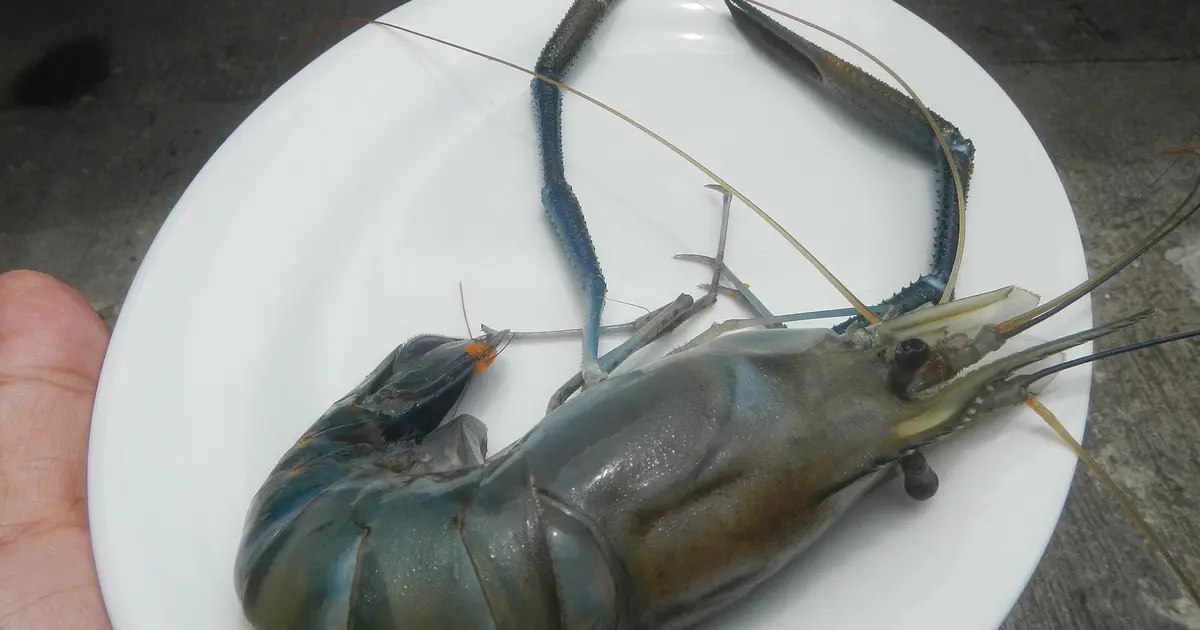
Giant freshwater prawn is the species that does not fit in a shrimp spec written for vannamei. It has long claws, a large head, a different shell and a different supply chain. Buyers who treat it as an oversized shrimp learn quickly that sizing, yield and handling follow their own rules.
This guide covers where the prawn comes from, how plants size and pack it, how to read yield and what to ask before an order.
What it is and where it is farmed
Macrobrachium rosenbergii lives in rivers and estuaries across South and Southeast Asia. It spends its larval stage in brackish water and the rest of its life in freshwater. Hatcheries produce post-larvae in brackish tanks, and farmers move them to freshwater ponds to grow out.
In the Mekong Delta the prawn is farmed in earthen ponds and in rotation systems with rice, where a field holds rice in one season and prawns in another. These systems sit mostly in the freshwater and low-salinity zones of provinces such as Can Tho, Hau Giang, Ben Tre, Tien Giang and Dong Thap. The rice-prawn system is attractive for farmers because it spreads the risk across two crops, and it is a story some buyers like to tell.
Most of the production goes to domestic markets as live or fresh product, where the large males command a premium. Export volumes are smaller and tied to buyers who want a large, distinctive prawn for premium restaurants, Asian retail and festive occasions.
How the prawn looks and why it matters
The prawn’s shape drives most of the spec. Males carry two long, thick front legs with claws, which can be as long as the body in the largest animals. Females have shorter claws and a rounder body shape. Color runs from blue-grey to green-brown on the shell, with blue on the claws of mature males, and turns orange-red when cooked.
Size varies widely in one pond. Male prawns follow a social structure in which dominant males grow fast and small males stay small, so a single harvest contains a mix of sizes and types. Plants sort by size after harvest, and the price per kilogram depends on how many large males the lot contains.
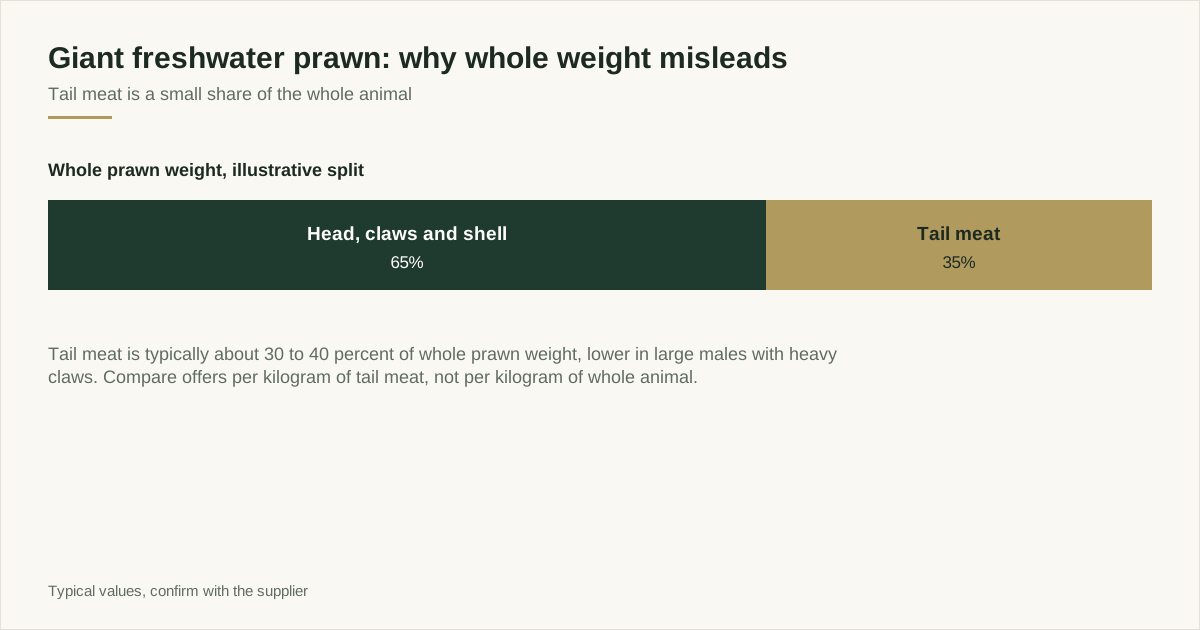
The head and claws make up a large share of the body weight, so the edible tail is a smaller share than in marine shrimp. This is the main reason for the difference in price per kilogram of meat.
Size grades and packs
Plants grade the prawn by the number of pieces per kilogram, not per pound, and the counts are far lower than for marine shrimp because the animals are larger. The table shows a typical way to describe grades. Actual ranges differ by plant.
| Grade by pieces per kg | Typical description | Typical use |
|---|---|---|
| Under 15 | Very large, mostly mature males | Premium restaurants, festive dishes |
| 15 to 25 | Large | Grill, steam, centre-plate dishes |
| 25 to 40 | Medium | Mixed foodservice, retail packs |
| 40 to 60 | Small | Soups, rice dishes, value packs |
Confirm the table with the plant and ask for a photo of a sample from each grade.
Packs vary with the processing form. Whole, head-on prawns often ship IQF in cartons of 1 to 2 kilograms, laid in a single layer or in bags. Headless shell-on prawns go in 1 kilogram bags in a master carton. Tail-only and peeled forms are less common, and a few plants offer them for further processing. Some buyers ask for claws removed to lower freight cost, and others want claws kept because the claws are part of the dish.
Yield: why whole weight misleads
A prawn with a whole weight of 100 grams may give a tail meat weight of 30 to 40 grams, depending on the size of the claws and the head. The share of meat is lower in the largest males because their claws are heavier. Use the numbers as a rough guide and ask the plant for the yield of its own product.
| Form | What you pay for | What you get |
|---|---|---|
| Whole head-on | Total animal weight | Meat plus head, claws and shell |
| Headless shell-on | Tail weight with shell | Tail meat plus shell |
| Peeled tail | Meat only | Meat, with a higher price per kilogram |
Compare quotes by converting each to the price per kilogram of tail meat. A whole prawn at a lower price per kilogram can cost more per kilogram of meat than a headless offer at a higher price. Our guide on shrimp processing forms explains how to calculate yield across forms, and the same method works here.
Glaze adds a second layer. A glazed whole prawn carries ice on the claws and the long antennae, which can be a large part of the glaze weight. Quote the net weight after deglazing, as described in the guide on glaze, net weight and yield.
Quality points to check
Freshwater prawn has its own defects, and a buyer should add them to the spec.
- Soft shell. Prawns that have just moulted have soft shells and poor texture. Plants should sort them at intake.
- Broken claws. Claws break off easily in handling and transport, and the share of intact claws affects the look of whole product.
- Muddy flavor. Freshwater ponds can give a muddy or earthy taste when the water and feed are poorly managed. Plants may purge the prawns in clean water before harvest. Ask about the practice.
- Black spot. Melanosis affects freshwater prawn like marine shrimp, and the guide on black spot in shrimp explains the causes and controls.
- Color. Shell color varies by pond and by season, and it matters less once the prawn is cooked.
Cooking and menu use
Cooks treat freshwater prawn differently from marine shrimp. The meat is sweet, firm and slightly fibrous, and it holds up to grilling, steaming, salt baking and braising. The large head carries rich fat and is a feature of many Southeast Asian dishes, which is why many buyers want head-on product. The claws take a long time to cook through and contain little meat, but they give a strong visual impression on the plate.
Overcooking turns the tail dry, so the cooking time depends on size. A chef who plans a menu item around the whole prawn should test a carton of each grade, record the cooking time and weigh the edible part of a portion. The test gives a cost per portion that a buyer can compare with other premium items, such as large marine shrimp or langoustine.
Ready to price this spec? Get matched with a shrimp supplier
Cold chain and glaze for head-on product
Head-on prawns lose quality faster than headless product because the head holds digestive enzymes that attack the body after harvest. A plant must chill the prawns quickly and freeze them soon after harvest. Ask how long the prawns stay between harvest and freezing, and ask for the freezer type and the core temperature at loading.
Glaze protects the long antennae and claws, which dry out quickly in cold storage. Plants therefore often apply a heavier glaze to head-on freshwater prawn than to headless shrimp, and a quote must make the net weight clear. Store the product at minus 18 degrees Celsius or colder and avoid temperature swings, which crack the glaze and cause freezer burn on the thin parts.
Supply, season and price
Supply depends on the farming cycle and on the weather. Prawns take several months to reach large sizes, and cold snaps or flooding can cut survival. The supply of large males is thinner than the supply of medium sizes, and prices for the largest grades can move sharply.
Price per kilogram runs well above marine shrimp of a similar weight because of lower yield, longer grow-out and a smaller supply base. Domestic demand during festivals also lifts the price, and export buyers compete with local buyers for the largest animals. Ask the plant how it reserves raw material for export and how far ahead you need to order.
Sustainability and farm story
Giant freshwater prawn carries a story that some buyers like: a freshwater species from delta ponds and rice fields. The story is useful only when the plant can document it. Ask which farms supply the lot, what system they use and which certificates they hold, and check each certificate with the issuer. A rice-prawn rotation, for example, is a farm system that a certifier can verify and a buyer can describe on a label only with that evidence.
Welfare and environmental practices vary by farm. Ask about pond water treatment, the source of post-larvae and the feed used. A plant that buys from a small group of known farms and keeps records for each lot can answer these questions, and a plant that buys through many collectors cannot. Our guide on shrimp traceability in the Mekong Delta explains how to test the chain.
Documents and market rules
Export documents follow the same pattern as for other aquaculture products: health certificate, product specification, lot traceability and laboratory results for residues. Residue rules apply as they do for shrimp, and buyers should read the destination market’s list. Our guide on antibiotic residue testing for EU and US entry shows which records to request.
Species labeling needs care. Use the full common name (giant freshwater prawn) and the Latin name Macrobrachium rosenbergii on the carton and the specification sheet. For the US, the FDA Seafood List gives the acceptable market name for Macrobrachium rosenbergii as “Shrimp, Freshwater”, with giant freshwater prawn as the common name. Do not call the product shrimp or tiger prawn if the label rules of your market treat the terms differently, and check the wording with your importer.
What to write in the request
- Species: Macrobrachium rosenbergii, with the Latin name.
- Form: whole head-on, headless shell-on or tail only, with claws on or off.
- Grade: pieces per kilogram range, with the tolerance and a photo chart.
- Glaze and net weight basis, with the price per kilogram of deglazed product.
- Quality limits: soft shell, broken claws and black spot.
- Annual volume, months and the grade mix you need.
- Documents: health certificate, specification sheet, lot traceability and residue results.
Next step
Decide whether you need the whole prawn with claws or a headless product, then write the seven lines above into one request. Send your spec through the request form and we match you with up to 3 Vietnam processors that handle freshwater prawn. They reply within 24 business hours with grade tables and photos from regular production.
Frequently asked questions
What is giant freshwater prawn?
It is Macrobrachium rosenbergii, a large river prawn with long claws that grows in freshwater and low-salinity ponds. It is a different species from the marine whiteleg and black tiger shrimp and has a distinct shape, with a big head and long front legs. In Vietnam it is often called blue-claw prawn.
How is giant freshwater prawn sized?
Plants usually grade by the number of pieces per kilogram and by whether the animal is whole, head-on or headless. Males vary widely in size within one pond, so the plant sorts into grades after harvest. Always ask for the grading table the plant uses and the tolerance.
Is the yield from whole prawn to tail meat low?
Yes. The head and claws make up a large part of the body weight, so the tail meat can be well under half of the whole prawn weight. Compare offers on tail meat weight, not on whole-animal weight, or the price will look better than it is.
Ready to price this spec?
Send your species, size grade and certificate list. We match you with up to 3 Vietnam processors and reply within 24 business hours.
Get matched with a shrimp supplier