Guides / Certification
Shrimp traceability from Mekong Delta pond to plant: what a buyer can actually verify
October 26, 2026
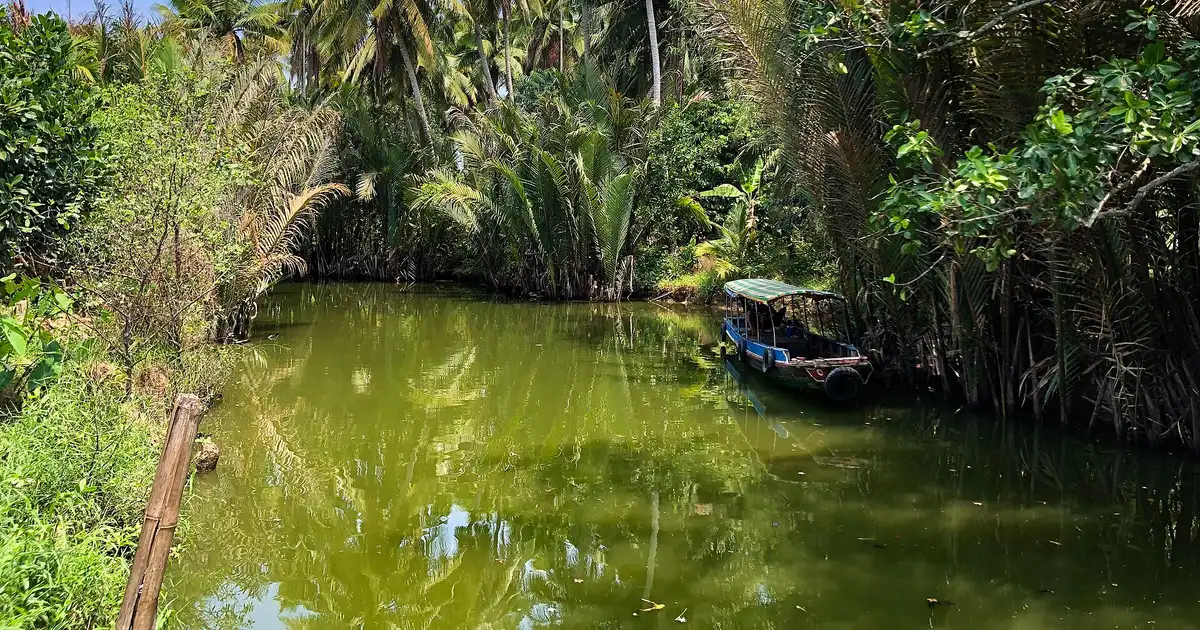
A buyer in Hamburg or Houston cannot visit a pond in Ca Mau or Bac Lieu. The carton is the only thing that arrives. Traceability is the chain of records that lets that buyer, a customs officer or a retailer’s auditor ask where the shrimp in one carton came from and get a precise, checkable answer.
This guide explains how traceability works in the Mekong Delta shrimp trade, where it breaks and what to ask a plant for.
Why the Mekong Delta shrimp chain is hard to trace
The delta holds a large share of Vietnam’s shrimp farming across provinces such as Ca Mau, Bac Lieu, Soc Trang, Ben Tre and Kien Giang. Farming here is largely in the hands of small producers who run one or a few ponds, in systems that range from extensive and mangrove-integrated to intensive whiteleg ponds with aeration. That structure delivers volume and variety, but it also means that a plant may draw from dozens or hundreds of farms in a season.
The shrimp rarely go straight from pond to plant. A typical path has the farmer harvest, a collector or agent buy and transport the live or iced shrimp, and the plant receive and process them. In some cases a depot holds shrimp from several farms for a short time before delivery. Each handover creates a place where one farm’s shrimp can mix with another’s, and where a record can be lost.
Traceability is the discipline of keeping the lots apart or, if they mix, of recording exactly what mixed.
The four links of a working chain
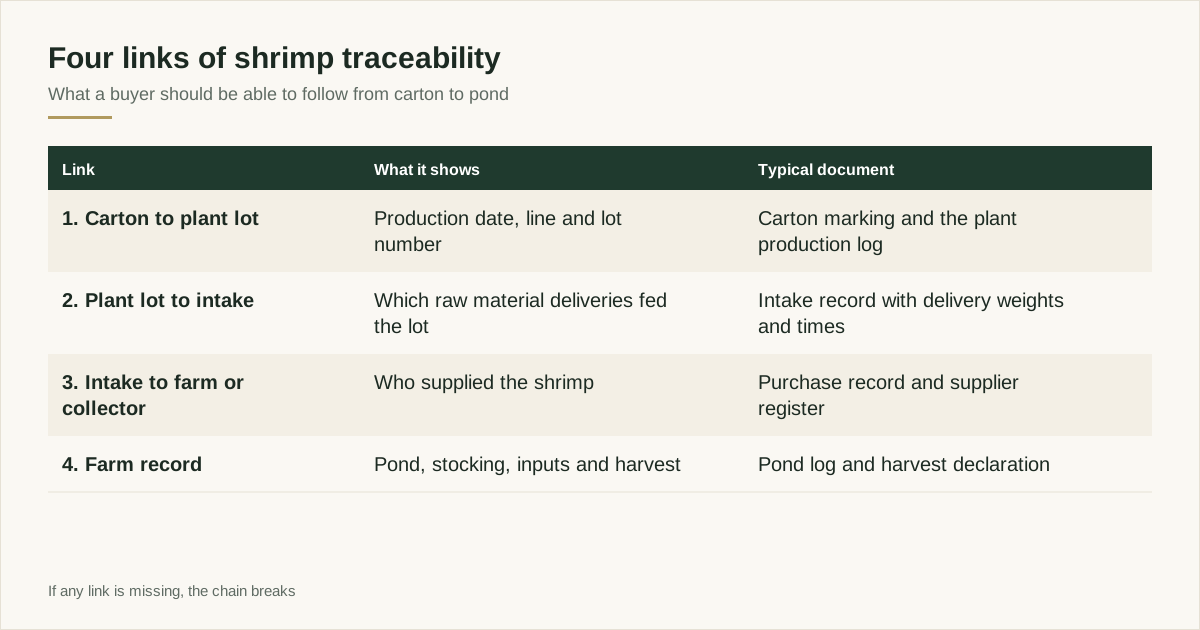
A traceable shrimp carton connects four records.
| Link | What it shows | Typical document |
|---|---|---|
| Carton to plant lot | Production date, line and lot number | Carton marking and the plant production log |
| Plant lot to intake | Which raw material deliveries fed the lot | Intake record with delivery weights and times |
| Intake to farm or collector | Who supplied the shrimp | Purchase record and supplier register |
| Farm record | Pond, stocking, inputs and harvest | Pond log and harvest declaration |
If any link is missing, the chain breaks. A plant that can show the first two links but not the last two has internal traceability only. That is normal for some plants, and it is a weakness for buyers who need farm-level origin.
What farm-level records should hold
Good farm records are short and specific. A pond log for one crop should show the pond identifier, the stocking date and the source of the post-larvae, the feed and other inputs with the supplier names and any treatment applied, with dates. It should also record the harvest date and quantity. The farm registration code, where the local authority issues one, links the pond to a registered operator.
Records of this kind support three buyer needs. They show the origin of the shrimp, they give a basis for residue control because the inputs are known, and they support farm-level sustainability schemes whose auditors check the same logs. Our guide on antibiotic residue testing for EU and US entry explains why input records matter when a laboratory finds a problem.
A pond log is only as good as the person who fills it in. Plants that run farmer training and check logs on site get better records than plants that ask for paperwork at the gate.
Where chains break in practice
Five weak points appear again and again in the delta.
- Collector mixing. A collector buys from several farms and delivers one mixed load. Without a split record, the plant cannot say which farm supplied which share.
- Late paperwork. Harvest declarations filled in after delivery, from memory, carry little evidence.
- Intake pooling. The plant combines deliveries into one tank or one lot for convenience, and the record shows only the pooled lot.
- Re-use of lot codes. A plant that reuses a code across days makes it impossible to tie a carton to a date.
- Subcontracting. A plant sends part of an order to another plant for peeling or packing, and the records of the second plant never reach the buyer.
The fix is simple but demands discipline: one lot code per production run, one intake record per delivery, a supplier register, and a written rule for what happens when shrimp from two sources are combined.
What the EU, US and Japan expect
All three markets expect traceability in some form, and the specifics are set in their own rules.
The EU general food law requires operators to trace food one step back and one step forward, and importers must be able to identify who supplied them and whom they supplied. The US applies the same principle through food traceability rules and, for shrimp, through the seafood import monitoring programme, which asks importers for data on the harvest and the producer of farmed shrimp and for record keeping over a set period. Japan expects importers to hold supply records and to provide them when an issue arises.
Detailed requirements change, so ask your importer or customs broker which data fields apply to your product today. Our guide on shrimp certifications by export market shows how traceability documents sit beside the other paperwork on a shipment.
Technology that helps, and its limits
Plants use several tools to link records. Barcode or QR labels on carton and tote make intake and lot data quick to capture. Simple software links the intake record to the lot and generates a report on request. Some plants give farms a mobile app to log inputs and harvest and to send the data ahead of delivery.
Technology helps when it captures data at the moment of the event. It does not help when staff type old data into a system after the fact. A buyer reviewing a plant’s system should ask to see a live example: pick a carton from the warehouse and ask the plant to trace it back to the farm in front of you or on a video call. The time the plant needs to produce the answer is a good measure of the system.
Ready to price this spec? Get matched with a shrimp supplier
How to run a traceability test
A trace test is the most informative audit step a buyer can take at low cost.
- Choose a lot code from a recent shipment or a carton in the warehouse.
- Ask the plant to produce the production record, the intake record and the supplier record within a set time, for example one working day.
- Check that the weights add up: intake weight, processing yield and finished weight should reconcile within a reasonable loss.
- Pick one supplier at random and ask for the pond log or harvest declaration for that delivery.
- Note any gaps and ask how the plant would close them.
Repeat the test every year, and after any change of plant or supply source.
Sustainability schemes and traceability
Farm-level sustainability schemes such as ASC and BAP rest on traceability. Their auditors check that the shrimp in a certified lot really came from a certified farm, and they audit the plant’s chain of custody to keep certified and non-certified shrimp apart. A plant that holds a chain of custody certificate has already built the intake and lot records a buyer needs, and a buyer can use the audit as a starting point.
A certificate is not a substitute for a trace test, though. A certified plant can still receive mixed deliveries when the rules are not followed on a busy day. The certificate belongs to the plant and the certification body, so check its status and scope with the issuer, and ask which farms and which lots fall inside it. Our guide on shrimp certifications by export market explains what each scheme covers.
What traceability costs and who pays
Traceability adds cost at every step. Farms spend time on logs, collectors spend time on split loads and plants spend time on intake records, labels and reports. Plants that run good systems build the cost into the price per kilogram, and the premium is usually small compared with the cost of a failed audit or a recall.
A buyer who asks for farm-level records on every lot should expect to pay a little more than a buyer who asks only for plant-level records. A phased approach works well: start with plant-level and intake records, add farm records for the lots your customer audits, and expand as the volume grows. Share the audit plan with the plant, so it prepares the right records and does not scramble when an auditor arrives.
What to ask for in the contract
- A unique lot code on every carton, and the same code on the packing list and the certificate.
- Farm-level records for each raw material lot, available on request within a stated time.
- A supplier register that lists the farms and collectors, with registration codes where they exist.
- A written rule on mixing: shrimp from different sources are either kept separate or recorded together.
- A statement that the plant will not subcontract production without written notice.
- Record retention for a set number of years, aligned with the rule of the destination market.
What to write in the request
- Destination market and the traceability data it requires.
- Level of traceability: plant lot, intake or farm level.
- Farm type, such as intensive whiteleg, extensive or mangrove-integrated, if it matters to your customer.
- Documents: lot code scheme, intake record sample and pond log sample.
- Test: a trace test on an existing lot before the first order.
- Contract terms: retention period and subcontracting rule.
Traceability feeds the supplier file in our guide to importing frozen shrimp from Vietnam.
Next step
Decide how deep your customer needs the trace to go, then write the six lines above into one request. Send your spec through the request form and we match you with up to 3 Vietnam processors that keep farm-level records. They reply within 24 business hours, and you can ask each one for a sample record set before you commit.
See also: the FSMA 204 traceability rule for shrimp.
Frequently asked questions
What does shrimp traceability mean in practice?
It means a buyer can follow a carton back to the plant lot, then to the raw material lots, then to the farm or collector and the harvest date. A working system links four records: the carton code, the plant lot, the intake record and the farm record. If one link is missing, the chain breaks.
Why is traceability harder for Mekong Delta shrimp?
Most shrimp in the delta come from many small farms, and shrimp often pass through a collector or agent before the plant. Each handover is a point where records can be lost or mixed. Plants that buy through fewer, registered farms and keep intake records for each lot trace more reliably.
Do EU and US importers require farm-level traceability?
Both require traceability of the product through the supply chain, and the US seafood import monitoring programme asks for specific data on farmed shrimp. The exact data fields and the retention periods differ, so confirm the current rules with your importer or broker before the first order.
Ready to price this spec?
Send your species, size grade and certificate list. We match you with up to 3 Vietnam processors and reply within 24 business hours.
Get matched with a shrimp supplier