Guides / Specification
Shrimp skewers from a Vietnam supplier: the spec lines for retail and foodservice
November 6, 2026
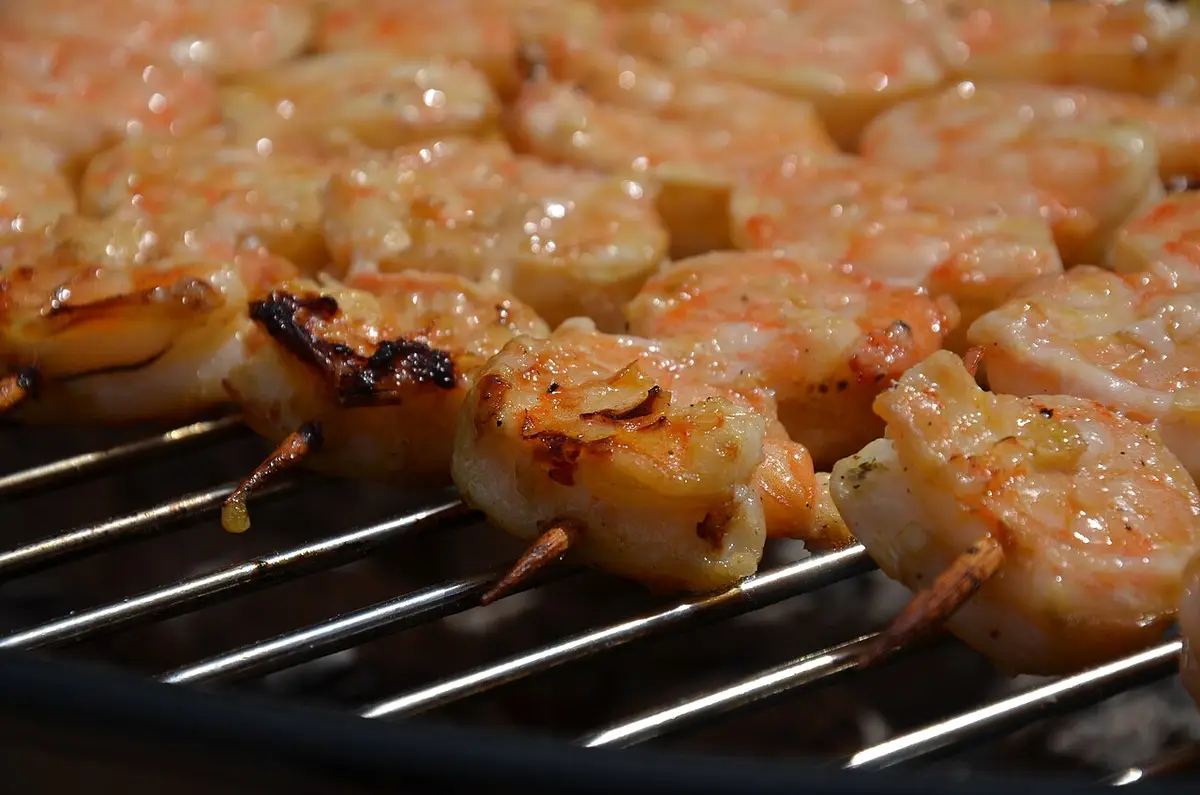
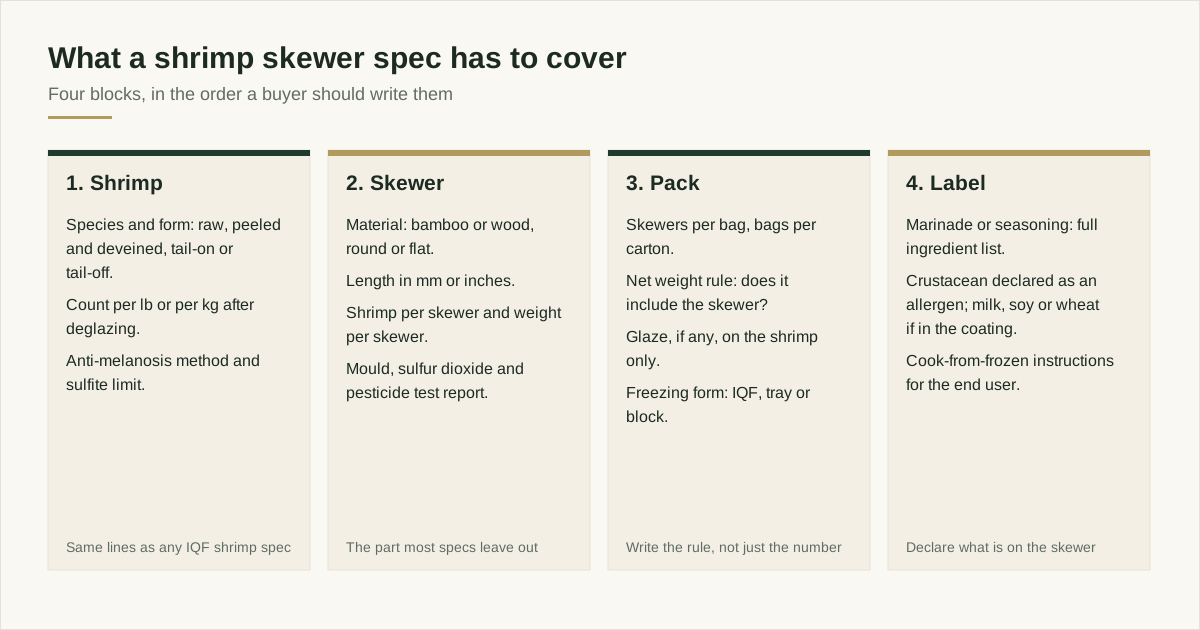
A shrimp skewers supplier has to agree four things with you, not one: the shrimp, the skewer, the pack rule and the label. The shrimp part is a normal spec of species, form, count and glaze. The other three are where orders go wrong, because a public product page rarely says how many shrimp sit on a skewer, whether the skewer counts toward net weight or what the marinade adds to the allergen list. This guide shows the lines to write for retail and foodservice orders, with the numbers you can calculate yourself and the ones the plant must state.
What public listings tell you, and what they skip
We opened three product pages for frozen shrimp skewers sold in Europe and North America. They are retail and distributor listings, so read them as examples of how little a typical listing says, not as a Vietnam price list or a standard.
| Listing | What it states | What it leaves out |
|---|---|---|
| IQF prawn skewer, Dutch distributor | Pacific white shrimp, peeled, deveined, raw, IQF, 100 g, 10 bags per carton, Vietnam origin | Skewer material and length, shrimp per skewer, whether 100 g is per skewer or per bag |
| Herb and garlic shrimp skewers, Canadian supplier | Bamboo skewers, 25 skewers in a bag, minimum box weight 2.0 kg, about 20 servings of 100 g, full ingredient list, cook from frozen | Shrimp per skewer, weight per skewer, storage text, origin |
| Raw shrimp skewers 10/4X3, US distributor | 6 inch flat wood skewer | The meaning of the 10/4X3 code, shrimp per skewer, weight, origin |
Two points stand out. First, none of the three tells you how many shrimp are on a skewer. Second, the marinated product lists dextrose, milk powder, soy sauce powder and wheat flour in its coating and declares shrimp, gluten, soy and wheat as allergens. A plain peeled skewer and a seasoned one are different products on the label even when the shrimp is identical.
The shrimp: size, count and what one skewer weighs
Start with the count grade, written the same way as for any peeled shrimp. Our guide to Vietnam shrimp size grades and how they set your price explains the per-pound count and the weight base. Then add the one number a skewer needs: shrimp per skewer.
The skewer weight follows from simple arithmetic. A pound is 454 g. A count of 21 to 25 per pound has a midpoint of 23, so one shrimp averages about 20 g (454 divided by 23). Four shrimp then weigh about 79 g and five weigh about 99 g. A count of 31 to 40 has a midpoint of 35.5, so one shrimp averages about 13 g, and five shrimp weigh about 64 g. These are calculations on a midpoint, not a market standard, and real lots scatter across the count range. They are still the fastest way to see whether a plant’s quoted skewer weight matches its quoted count.
Write three lines:
- Count grade of the shrimp, on deglazed weight. Peeled and deveined, tail-on or tail-off.
- Shrimp per skewer, as a fixed number, for example 4 or 5. Say whether the tail points up or all shrimp lie the same way, because that changes how a skewer packs and how it looks in the tray.
- Target weight per skewer with a tolerance. A skewer can then be weighed in an inspection and compared to what the plant declared.
Raw skewers freeze one of three ways: IQF, tray or block. IQF keeps skewers separate so a foodservice kitchen can pull 20 from a bag, and our guide to IQF, semi-IQF and block frozen shrimp covers what each form means for glaze and breakage. Skewers add a fourth point: a skewer that freezes in a bent position can pierce the bag. Ask for the packing method, such as trays or a sleeve, before the first container.
The skewer: material, length and a test report
The skewer is a material that touches the food for a long time, and in a frozen pack it sits in the product through freezing, storage and thawing. Three lines cover it:
- Material and shape. Bamboo or wood, round or flat. Length in millimetres or inches.
- Food contact compliance. In the EU, the framework regulation requires that materials in contact with food do not release constituents in amounts that endanger health, change the food or worsen its taste or smell (Regulation (EC) No 1935/2004, Article 3). It also requires traceability of materials at every stage (Article 17). In the sources we opened, we found no US rule written for wooden or bamboo skewers, so ask the plant what standard its skewer maker works to.
- A test report from the skewer maker. Ask for mould count, sulfur dioxide and pesticide residue. A Hong Kong Consumer Council test of 18 bamboo toothpicks and skewers in 2011 found that two makes of skewer had mould counts of 130 and 800 cfu/g against a 50 cfu/g limit in a mainland China standard for disposable bamboo chopsticks, and that four skewers and one toothpick had sulfur dioxide of 112 to 253 mg/kg against a 100 mg/kg limit in a draft mainland standard for toothpicks. The same page notes that no international safety standard applies to bamboo pin products. It is an old test on retail products in one market, and it tells you only that these hazards exist and that a supplier declaration is not enough.
A plant that buys skewers from a trader may not have these reports at hand. The request itself is useful: a plant that can send the report in a day has already asked the question of its supplier.
The pack: where the skewer sits in the net weight
Net weight rules for frozen shrimp measure the shrimp, with glaze removed. In the EU, the rule on glazed food says the declared net weight excludes the glaze (Regulation (EU) No 1169/2011, Annex IX). Our guide to glaze, net weight and yield in shrimp quotes shows how to measure it. A skewer is neither shrimp nor glaze, so the rule is silent, and a plant may declare either way.
Settle it in writing:
- Is the declared net weight shrimp only, or shrimp plus skewer? Shrimp only is the cleaner choice for a buyer who compares quotes by the kilo.
- Is the price per kilo of shrimp, or per skewer? Per skewer is common in retail packs. Then state the shrimp weight each skewer must hold.
- Pack structure. Skewers per bag, bags per carton and net weight of each. The distributor listings above show how different these are: 10 bags of 100 g in one carton, or 25 skewers in a bag with a minimum box weight of 2.0 kg.
- Glaze. On the shrimp only, with the percentage and the method named.
- Fixed or catch weight. A fixed count of skewers per bag gives a fixed unit count and a variable weight. Our guide to catch weight and fixed weight shrimp packs covers how to invoice each.
Ready to price this spec? Get matched with a shrimp supplier
The label: marinade, allergens and sulfite
An unseasoned skewer carries a short label: the shrimp, a sulfite declaration if a sulfite dip was used and the allergen statement. Crustaceans are on the EU allergen list (Regulation (EU) No 1169/2011, Annex II). In the United States, crustacean shellfish is one of the nine major allergens, and the label must name the species, for example shrimp (FDA, Food Allergies page). Our guide to sulfite in shrimp gives the limits and the label thresholds.
A seasoned or marinated skewer adds three tasks:
- Full ingredient list from the plant, not a summary. A coating can bring milk, soy, wheat or other allergens, as the seasoned listing above shows.
- A label that matches the destination. US, EU and Japan rules differ on wording and allergen lists. Send the plant your market’s label text, not the other way round.
- Cooking instructions. Say whether the skewer is cooked from frozen or thawed first, and at what temperature. The seasoned listing above gives a cook-from-frozen method to an internal temperature of 145 F (63 C). Write your own method into the spec and check it matches your regulator’s guidance.
For foodservice packs, add the portion logic. Our guide to foodservice portion counts and packs lists how kitchens buy by portion and how a pack that does not divide into portions costs the kitchen waste.
Spec lines to copy into your request
- Species, form (raw or cooked), peeled and deveined, tail-on or tail-off.
- Count grade per lb or per kg on deglazed weight.
- Shrimp per skewer and target weight per skewer, with tolerance.
- Skewer material, shape and length.
- Test report from the skewer maker: mould, sulfur dioxide, pesticide residue.
- Net weight rule: shrimp only, or shrimp plus skewer. Price basis: per kilo or per skewer.
- Pack structure: skewers per bag, bags per carton, glaze percentage.
- Marinade: yes or no, with full ingredient list and allergens.
- Anti-melanosis method and sulfite limit.
- Label text for the destination market and cooking instructions.
Next step
Fill in the ten lines, even if some stay open, and send them through the request form. We match you with up to 3 Vietnam processors, and they reply within 24 business hours. Their answers to lines 3, 5 and 6 show quickly which plants have packed skewers before.
See also: the PDTO shrimp specification: peeled, deveined, tail on.
Sources
- Regulation (EC) No 1935/2004 on materials and articles intended to come into contact with food, Articles 3 and 17 (EUR-Lex)
- Regulation (EU) No 1169/2011 on food information to consumers, Annex II and Annex IX (EUR-Lex)
- FDA, Food Allergies: the nine major allergens and species labelling for crustacean shellfish
- Hong Kong Consumer Council, CHOICE 411, test of bamboo toothpicks and skewers (14 January 2011)
- Zeelandia-Van Belzen, IQF prawn skewer product page (distributor listing, directional)
- Sealand Quality Foods, herb and garlic shrimp skewers product page (supplier listing, directional)
- Raw Seafoods, all-natural shrimp skewers 10/4X3 product page (distributor listing, directional)
Frequently asked questions
How many shrimp go on a skewer?
No standard sets it. Public product pages from distributors often leave it out, so the buyer has to fix it in the order. Pick the count of shrimp per skewer and a target weight per skewer, then check both on a deglazed sample. The weight per skewer is the number of shrimp times the average piece weight of the size grade.
Is the skewer included in the net weight of shrimp skewers?
It depends on what you write. Net weight rules for frozen shrimp measure the shrimp without glaze, and a skewer is not shrimp. State in the spec whether the declared net weight is shrimp only or shrimp plus skewer, and whether the price is per kilo of shrimp or per skewer. Without that line the plant and the buyer can read the same invoice two ways.
Do bamboo skewers need a test report?
Ask for one. The EU framework rule says a material in contact with food must not release constituents in amounts that endanger health, and a Hong Kong test found mould above a 50 cfu/g reference in two of eight bamboo skewers and sulfur dioxide above 100 mg/kg in four. A report on mould, sulfur dioxide and pesticide residue from the skewer maker shows the plant checked.
What allergens go on a shrimp skewer label?
Crustacean shellfish always, because the shrimp is the product. The US requires the species to be named, for example shrimp. A marinade or coating adds its own allergens, such as milk, soy or wheat, and they must also appear. Send the plant your market's label rules together with the full marinade recipe.
Ready to price this spec?
Send your species, size grade and certificate list. We match you with up to 3 Vietnam processors and reply within 24 business hours.
Get matched with a shrimp supplier