Guides / Certification
RASFF shrimp notifications: why EU border checks reject lots and how a buyer prevents it
November 9, 2026
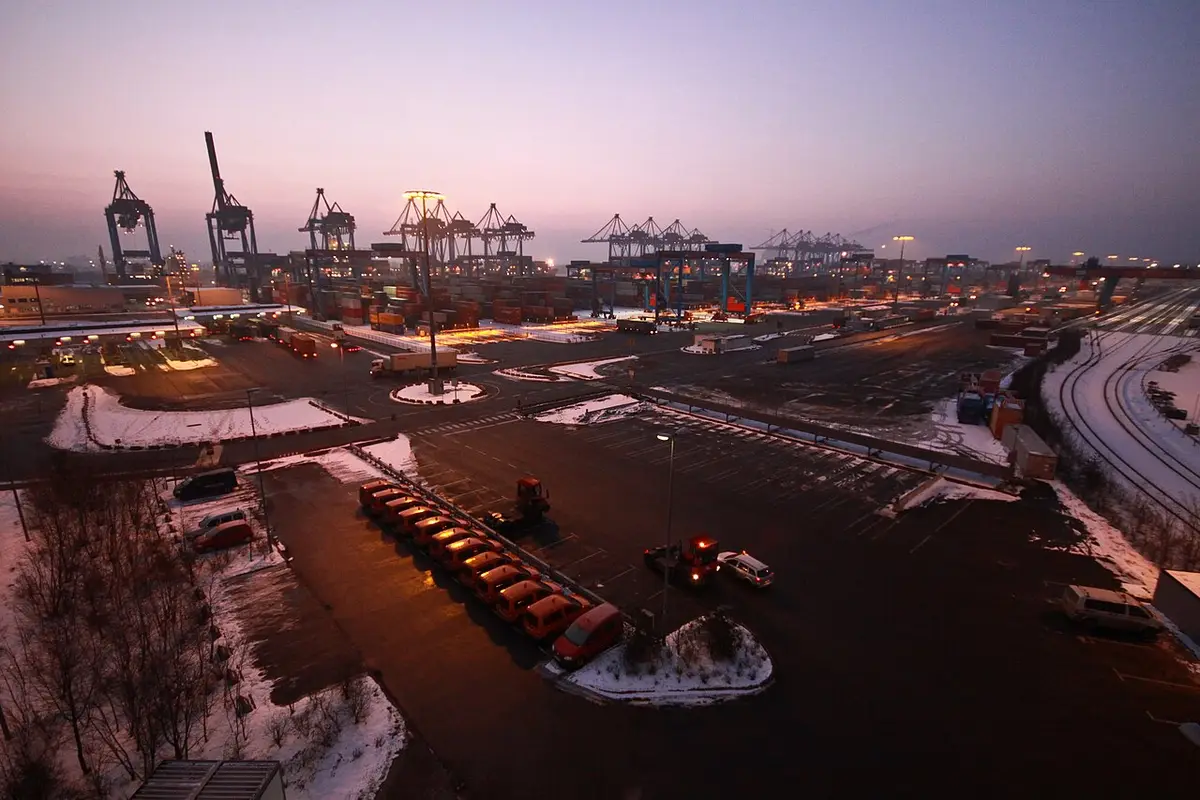
A RASFF border rejection is a notice that the EU refused a food consignment at the border because of a health risk, and in the public digests we opened, shrimp notices come back to a short list of repeat reasons: drug residues above the EU reference points, undeclared sulfite or allergens on the label, pathogens in cooked product and cold chain failures. The notice goes to every EU border post and to the country of origin, so one rejected lot follows the plant. This guide explains how the system classifies notices, what a border check looks at, what happens to a rejected lot and what a buyer checks before the container sails.
What RASFF is and what the notices say
RASFF is the rapid alert system for food and feed set up by Regulation (EC) No 178/2002. Member states, the Commission and EFSA take part. A member that has information about a serious direct or indirect risk to human health from food must notify the Commission immediately, and it must also report national measures such as withdrawals, recalls and border rejections of consignments that pose a risk. For a border rejection, the Commission alerts all EU border posts and the country of origin. Article 52 says information about the risk is generally public: the product, the nature of the risk and the measures taken.
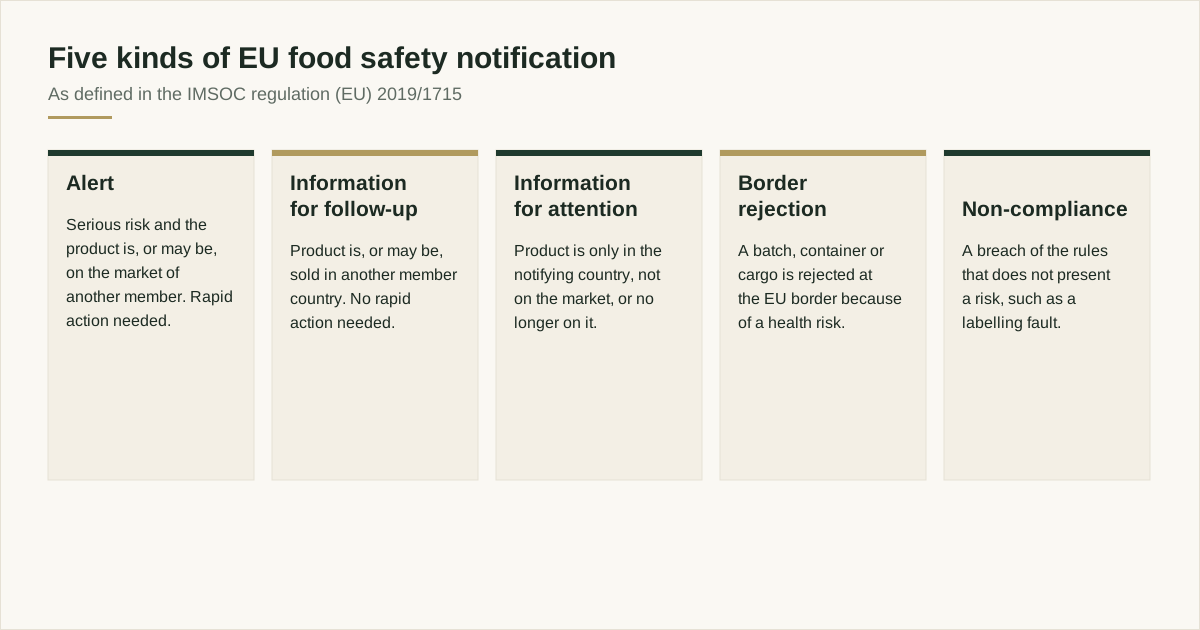
The IMSOC regulation (EU) 2019/1715 sorts notices into five types:
- Alert: a serious risk and a product that is, or may be, on another member’s market, needing rapid action. It must be submitted within 48 hours.
- Information for follow-up: a product that is, or may be, sold in another member country, with no rapid action needed.
- Information for attention: a product that is only in the notifying country, not yet on the market or no longer on it.
- Border rejection: a batch, container or cargo rejected on health grounds, sent through TRACES to all border control posts.
- Non-compliance: a breach that does not present a risk.
For an importer the border rejection is the one that costs a container, and the alert is the one that follows a lot already sold.
What happens at the border
Official controls at an EU border control post have three layers: a documentary check on all consignments, an identity check and a physical check, with the last two at a risk-based frequency (Regulation (EU) 2017/625, recital 57 and Article 3). A physical check on products of animal origin, as set out in Implementing Regulation (EU) 2019/2130, covers these items:
- The transport temperature records, to confirm the cold chain held, plus the integrity of packaging and transport.
- Labelling.
- Organoleptic checks of smell, colour and consistency, and simple cutting, defrosting or cooking tests.
- Sampling, set at 1 percent of the items or packages with a minimum of two and a maximum of ten, plus laboratory tests for hazards under a risk-based monitoring plan.
A consignment sampled under the monitoring plan may be released to the market before the results arrive, provided no immediate danger is suspected, and the results are recorded in the entry document as soon as they are known. So a problem can also surface after the lot has entered the market, as an alert notice instead of a border rejection.
The usual causes in shrimp notices
The RASFF Window database is the primary source, and it was not readable for this guide. The cases below come from monthly digests that summarise RASFF notices, and from the EU rules. Treat the digests as secondary and check the original notice for any number you rely on.
| Cause | EU rule | Example in public digests |
|---|---|---|
| Nitrofuran metabolites | Reference point for action of 0.5 µg/kg for each metabolite (AOZ, AMOZ, AHD, SEM and DNSH) | An April 2023 digest lists a nitrofuran metabolite at 13.2 µg/kg in frozen raw vannamei shrimp from Vietnam against 0.5 µg/kg |
| Chloramphenicol and malachite green | Reference points of 0.15 µg/kg and 0.5 µg/kg (malachite green and leucomalachite green together) | No example opened for this guide. FDA also lists these substances for shrimp firms, see our FDA import alert guide |
| Undeclared sulfite | Sulfite above 10 mg/kg needs a label declaration; limits apply by size band | A 2025 digest lists 23 mg/kg of undeclared sulfite in frozen shrimp from Vietnam, notified by France. An April 2023 digest lists 216 mg/kg in cooked shrimp from Spain against 135 mg/kg |
| Undeclared allergen in a coating | Allergens must be declared in the ingredient list | Vietnam’s SPS Office reported in February 2025 that frozen breaded shrimp had undeclared egg in the coating and was recalled |
| Salmonella in cooked product | Cooked crustaceans: absence in 25 g, five samples, none positive, during shelf life (Regulation (EC) No 2073/2005, row 1.16) | A digest lists Salmonella in frozen shrimp from Bangladesh via the Netherlands, and the criterion above covers only cooked product |
| Cold chain | Temperature records are part of the physical check | The 2024 EU network summary reported frequent temperature control problems with frozen fish products |
Three points on the table. First, the reference points for action apply since 28 November 2022: food of animal origin with residues at or above them is non-compliant and must not enter the food chain (Regulation (EU) 2019/1871, Articles 5 and 8). They cover shrimp and apply to any food matrix. Second, a buyer cannot tell a clean lot from a listed one by the price, so the evidence is the lab report. Third, the EU label threshold for sulfite is 10 mg/kg as total SO2, so a lot far below the 150 to 300 mg/kg limit can still be rejected for a missing declaration, as our guide to sulfite in shrimp explains, with the limits and the label wording.
On the scale of the system, the 2024 report of the EU Alert and Cooperation Network recorded 5,250 RASFF notifications, 12 percent more than in 2023, with around a third of them border rejections and fish and fish products about 4 percent of all notifications, as summarised by Food Safety News. That coverage does not break out crustaceans, so use the RASFF Window filter for crustaceans and your origin to see current counts.
What happens to a rejected lot
Regulation (EU) 2017/625, Article 66, sets the outcome for a non-compliant consignment:
- The authority places it under official detention and refuses entry.
- After hearing the operator, except where immediate action is needed, it can order the operator to destroy the consignment, send it back outside the EU or apply a special treatment.
- The decision is notified through IMSOC to the Commission, other member states, customs, the country of origin and the operator.
- The measures are at the operator’s expense, and the operator must carry them out within 60 days of notification unless the authority sets a shorter period (Article 69).
Send-back is possible only where the conditions in Article 72 are met, and a frozen lot sitting in port accrues storage cost throughout. A cargo that was already paid for becomes a claim against someone, and our guide to documenting a shrimp quality claim shows how to assemble the evidence.
Ready to price this spec? Get matched with a shrimp supplier
What to check before the container sails
- Residues. Ask for a lab report on the lot for the substances above, with the method named and a limit of quantification at or below the reference point. Our guide to antibiotic residue testing for EU and US entry covers the sampling.
- Sulfite and phosphate. Write the anti-melanosis method and the declared additives into the spec and match the label to it. The soaking and non-phosphate agents guide covers the second.
- Coatings and sauces. Obtain the full recipe, and check every allergen against the label. Our guide to breaded and tempura shrimp lists what a coating adds.
- Cooked product. Ask for the Salmonella result for the lot, and for the plant’s cooking and cooling records.
- Cold chain. Follow the reefer loading guide: product temperature at loading, a data logger and photographs of the load.
- Traceability. A residue finding must lead back to a farm. See pond-to-plant traceability.
- Contract. Name who pays for storage, testing, return or destruction if the lot is rejected, and how long the buyer has to give notice.
Duty is a separate topic. Our guide to the EVFTA shrimp tariff covers the zero-duty route and its origin rules, and a rejection at the border makes the tariff question academic.
The EU border is one step in our guide to importing frozen shrimp from Vietnam.
Next step
Write the seven checks into your request and send them through the request form. We match you with up to 3 Vietnam processors, and they reply within 24 business hours. Compare how each plant handles the lab report, the label and the cold chain, since those three are where border rejections start.
See also: EU shrimp import requirements, as of October 2026.
See also: EU limits and reference points for drug residues in shrimp.
Sources
- Regulation (EC) No 178/2002, Articles 50 to 52 on the rapid alert system (EUR-Lex)
- Implementing Regulation (EU) 2019/1715, IMSOC, definitions of notification types (EUR-Lex)
- Regulation (EU) 2017/625 on official controls, Articles 3, 47, 66 and 69 (EUR-Lex)
- Implementing Regulation (EU) 2019/2130, identity and physical checks at border control posts (EUR-Lex)
- Implementing Regulation (EU) 2019/1871, reference points for action (EUR-Lex)
- Regulation (EC) No 2073/2005 on microbiological criteria for foodstuffs, Annex I (EUR-Lex)
- Food Safety News, Europe records rise in food safety alerts (summary of the 2024 ACN report)
- Agrolab, RASFF notices digest, April 2023 (secondary summary, directional)
- Agrolab, RASFF notices digest, 2025 (secondary summary, directional)
- Viet Nam News, EU warnings against Viet Nam’s food exports, 15 February 2025 (SPS Office)
Frequently asked questions
What is RASFF?
RASFF is the EU Rapid Alert System for Food and Feed. Member states, the Commission and EFSA use it to share notices about food that may be a health risk. Under Regulation 178/2002 a member that has information on a serious risk must notify at once, and border rejections of risky consignments are reportable.
What is a border rejection notification?
It is a notice that a batch, container or cargo of food was rejected at the EU border because of a health risk. It is one of five notification types. The border authority sends it through the EU network to all border control posts and to the country of origin, so the rejection is visible far beyond the one port.
What happens to a shrimp lot that is rejected at the EU border?
The authority detains the consignment, refuses entry and can order the operator to destroy it, send it back outside the EU or apply a special treatment. Costs fall on the operator, and the operator normally has a chance to be heard first. Ordered measures must be carried out within 60 days unless the authority sets a shorter period.
Which shrimp problems appear most in EU notifications?
Drug residues above the EU reference points, undeclared sulfite or allergens on the label, and pathogens such as Salmonella in cooked product are the repeat causes in the public digests we opened. Cold chain failures also appear in EU fish figures. Check the RASFF Window database for current counts by product and origin.
Ready to price this spec?
Send your species, size grade and certificate list. We match you with up to 3 Vietnam processors and reply within 24 business hours.
Get matched with a shrimp supplier