Guides / Logistics
EVFTA shrimp tariff: when Vietnam shrimp enters the EU duty free and what origin proof you need
October 30, 2026
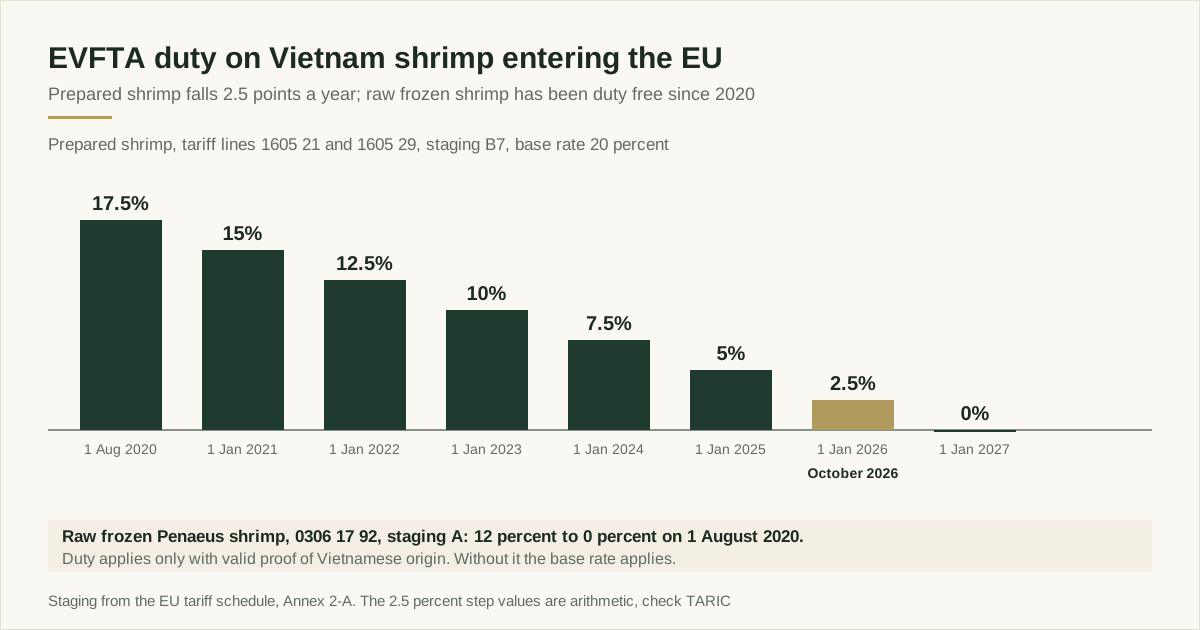
An EU importer pays no customs duty on raw frozen Vietnam shrimp of the genus Penaeus when the shipment qualifies as originating in Vietnam under the EU-Vietnam trade agreement (EVFTA). The duty on that line was 12 percent and fell to zero when the agreement entered into force on 1 August 2020. Prepared shrimp, such as breaded or cooked product under heading 1605, started at 20 percent and reaches zero on 1 January 2027. The zero rate has a condition: the shrimp must meet the origin rule and the shipment must carry valid proof of origin. This guide shows the rates, the rule and the paperwork, as of October 2026.
What the EU tariff schedule says
The tariff schedule of the Union, which is Appendix 2-A-1 of the agreement, lists a base rate and a staging category for every line. Category “A” means the duty is removed entirely on the date of entry into force. Category “B7” means the duty is removed in eight equal annual stages, with the first reduction on that date and each later reduction on 1 January of the following years.
| Product line (CN 2012 code in the schedule) | Base rate | Category | Status in October 2026 |
|---|---|---|---|
| 0306 17 92, shrimps of the genus Penaeus, frozen | 12 percent | A | Zero since 1 August 2020 |
| 0306 17 99, other frozen shrimps and prawns | 12 percent | A | Zero since 1 August 2020 |
| 0306 17 10, smoked shrimps | 20 percent | A | Zero since 1 August 2020 |
| 1605 21 10 and 1605 21 90, prepared shrimp not in airtight containers | 20 percent | B7 | 2.5 percent, zero on 1 January 2027 |
| 1605 29 00, other prepared shrimp | 20 percent | B7 | 2.5 percent, zero on 1 January 2027 |
Two notes on the table. First, the 2.5 percent figure is our arithmetic: 20 percent divided into eight equal stages is 2.5 points a stage, and seven stages have taken effect by October 2026. Second, the schedule uses the 2012 version of the EU Combined Nomenclature. The code numbers have been revised since, so look up your product in the current EU TARIC database or in the Access2Markets tool and check that the preferential rate for Vietnam matches the table.
Classification follows the form of the product. Raw frozen shrimp sits in chapter 3. Breaded, tempura and other prepared lines sit in chapter 16. Where a cooked and peeled line falls is a classification call for your customs broker, and it matters because the two chapters follow different schedules. Our guide to shrimp processing forms explains the product forms behind those lines.
The origin rule in plain words
A zero rate is a preference, and the EU grants it only to goods that originate in Vietnam. Protocol 1 of the agreement sets the rule, and for shrimp it is strict.
- Wholly obtained. Article 4 treats aquaculture crustaceans as wholly obtained in a Party when they are born or raised there from eggs, fry or larvae. Shrimp grown in a Vietnamese pond from larvae meet this.
- Chapter 3. The product rule in Annex II says that all fish and crustaceans of chapter 3 must be wholly obtained. For frozen shrimp under heading 0306 the working condition is the same: every chapter 3 material used must be wholly obtained.
- Chapter 16. The rule for prepared products requires that all materials of chapters 2, 3 and 16 used are wholly obtained. It sets no such limit on other inputs, such as flour or oil for breading, but your broker should check the rule for your exact line.
- No ASEAN cumulation for shrimp. The protocol lets Vietnam count materials from ASEAN partners that have an EU trade agreement, but its annexes list only squid and octopus products. Shrimp from another country that is finished in Vietnam does not gain Vietnamese origin. These are the rules as signed in 2019, and annexes can be amended, so ask your broker to check the current consolidated text.
| Case | Qualifies for the EVFTA rate? |
|---|---|
| Shrimp farmed in Vietnam, frozen in a Vietnamese plant | Yes, if the proof of origin is valid |
| Breaded shrimp made from Vietnam-farmed shrimp | Yes under the chapter 16 rule as written, subject to the broker check above |
| Shrimp farmed in another country, peeled and frozen in Vietnam | No, normal EU duty applies |
| Vietnam shrimp that was altered or processed in a third country before entering the EU | At risk, because the products must stay unaltered in transit |
On the last row, Article 13 says that products declared in the EU must be the same products exported from Vietnam. Storage and splitting are allowed only under customs supervision in the transit country. A container that transships through a hub without being opened is the normal case. A container that is opened, repacked or relabelled outside customs control is not.
For a buyer the practical consequence is raw material traceability. If a plant draws shrimp from farms in more than one country in a season, the origin of each production lot has to be provable. Our guide on pond to plant shrimp traceability shows what a lot record should carry.
Proof of origin: three routes
Under Article 15 of Protocol 1, a product from Vietnam gets the preference when the importer presents one of three kinds of proof.
- An EUR.1 certificate issued by the competent authorities of Vietnam on the exporter’s application.
- An origin declaration made out by any exporter for consignments up to a total value that Vietnamese law sets and that cannot exceed EUR 6,000.
- An origin declaration by an approved or registered exporter, under Vietnamese legislation, once Vietnam has notified the EU that it applies that system to its exporters. Any consignment value qualifies.
A proof of origin is valid for 12 months from the date of issue and must reach EU customs within that period. In some cases of late presentation the customs authority may still accept it. Which of the three routes your supplier uses depends on current Vietnamese practice, so ask for the sample proof with the first quotation and let your broker review it before the first shipment.
Ready to price this spec? Get matched with a shrimp supplier
Where a claim fails
- The proof names an exporter other than the one on the invoice.
- The proof is missing at the time of entry and the preference is lost with it.
- The shrimp or part of the lot came from outside Vietnam and the plant cannot show a lot record.
- The container was opened or changed outside customs supervision on the way.
- The product code on the proof does not match the code on the entry.
- The 12 months expired before presentation.
What a failed claim costs
The figures below are arithmetic on a round customs value of EUR 100,000, not a quote. They use the base rates from the schedule.
| Product | Duty with valid proof | Duty without it | Difference |
|---|---|---|---|
| Raw frozen Penaeus shrimp, 0306 17 92 | EUR 0 | EUR 12,000 | EUR 12,000 |
| Prepared shrimp, 1605 21 or 1605 29, October 2026 | EUR 2,500 | EUR 20,000 | EUR 17,500 |
| Prepared shrimp, from 1 January 2027 | EUR 0 | EUR 20,000 | EUR 20,000 |
Duty is only one of the gates into the EU. Plant listing, health certificates and residue testing are separate, and our guides on antibiotic residue testing for EU and US entry and certifications by export market cover them. To see how origin choice changes the price comparison, read Vietnam vs India vs Ecuador shrimp suppliers.
What to write in the request
- Product form and the EU code you will enter under, agreed with your broker.
- A statement that the raw material is wholly obtained in Vietnam, with lot records on request.
- The proof of origin route: EUR.1 or origin declaration, and who signs it.
- The exact exporter name, the same on the invoice, the packing list and the proof.
- The transit route and a rule that the container stays sealed outside customs supervision.
- A price basis that names who bears the duty if the proof is rejected.
The EU duty is one line of the landed cost in our guide to the Vietnam shrimp export price.
Next step
Choose your product form, find its current rate in TARIC and write the origin conditions above into the request. Send your spec through the request form and we match you with up to 3 Vietnam processors. They reply within 24 business hours, and you can compare how each one documents its raw material and its proof of origin.
See also: EU shrimp import requirements, as of October 2026.
Sources
- Council of the European Union, EU-Vietnam trade agreement, Annex 2-A, reduction or elimination of customs duties (document 6051/19 ADD 1)
- EU-Vietnam trade agreement, Appendix 2-A-1, tariff schedule of the Union (copy hosted by Vietnam’s WTO and FTA Centre)
- EU-Vietnam trade agreement, Protocol 1 on rules of origin (copy hosted by Vietnam’s WTO and FTA Centre)
- European Commission, EU-Vietnam trade agreement overview
Frequently asked questions
Is there a duty on frozen shrimp from Vietnam to the EU?
Not on raw frozen shrimp of the genus Penaeus, which includes vannamei and black tiger, when the shipment qualifies as originating in Vietnam under the EVFTA. The EU duty on that line fell from 12 percent to zero on 1 August 2020. Without valid proof of origin the full 12 percent applies.
Does breaded or cooked shrimp from Vietnam also enter the EU duty free?
Prepared shrimp under heading 1605 21 and 1605 29 is on a longer phase-out. The base duty of 20 percent falls in eight equal annual stages. On our reading of the schedule it stands at 2.5 percent in October 2026 and reaches zero on 1 January 2027. Confirm the rate in the EU TARIC database.
Does shrimp from another country that is processed in Vietnam qualify for the EVFTA rate?
No. For shrimp in chapter 3 and for prepared shrimp in chapter 16 the rule requires that the shrimp used are wholly obtained in Vietnam. ASEAN cumulation covers only squid and octopus products. Shrimp raised in India, Ecuador or Thailand and finished in a Vietnamese plant pays the normal EU duty.
What proof of origin does an EU importer need for the EVFTA rate?
Protocol 1 allows an EUR.1 certificate issued by the Vietnamese authorities, or an origin declaration. Any exporter may make the declaration for small consignments, capped at EUR 6,000 and set by Vietnamese law. Above that it must come from an approved or registered exporter. The proof stays valid for 12 months.
Ready to price this spec?
Send your species, size grade and certificate list. We match you with up to 3 Vietnam processors and reply within 24 business hours.
Get matched with a shrimp supplier