Guides / Specification
Cooked shrimp from Vietnam: how cook yield and Listeria control shape the spec
October 10, 2026
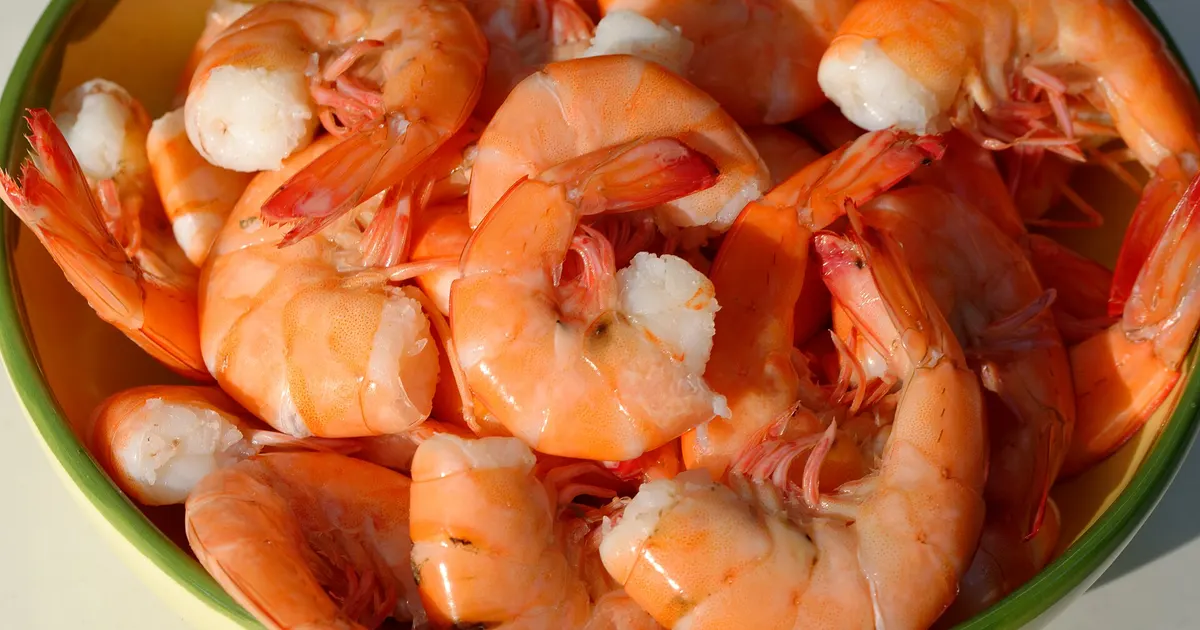
Cooked frozen shrimp looks like the simplest product in the trade: raw shrimp go in, hot water does the work and a pink shrimp comes out. In practice it is the format where two numbers decide whether the order works. The first is cook yield, which sets what you really pay per kilogram of finished product. The second is Listeria control, which decides whether the plant can ship to the United States and the EU at all.
This guide walks through the cooked line from raw material to carton and lists the evidence a buyer should ask for.
How a cooked shrimp line works
A typical cooked shrimp line has six steps. Raw shrimp arrive, are washed and graded by size, and then enter the cooker. Plants use either a steam cooker or a hot water cooker, and in both cases a conveyor sets the cooking time so each shrimp receives the same heat. The shrimp leave the cooker and move straight into a chiller where cold water or cold air brings the core temperature down quickly. After chilling, an inspection belt removes broken or poorly cooked shrimp, an IQF freezer sets the shape and a glaze and pack step follows.
The cooker is a control point. Under-cooking leaves the meat translucent in the middle and raises a food safety flag. Over-cooking drives out more water, makes the meat rubbery and cuts the yield. Plants set a core temperature target for each size and check it with a probe at fixed intervals. Ask the plant for its core temperature target and the frequency of checks.
The chiller is the second control point. Slow cooling leaves shrimp warm for longer than they should be, and that is the window in which bacteria multiply. A well-run chiller brings shrimp from cooking temperature to a low single-digit core temperature within minutes.
What cook yield means for your price
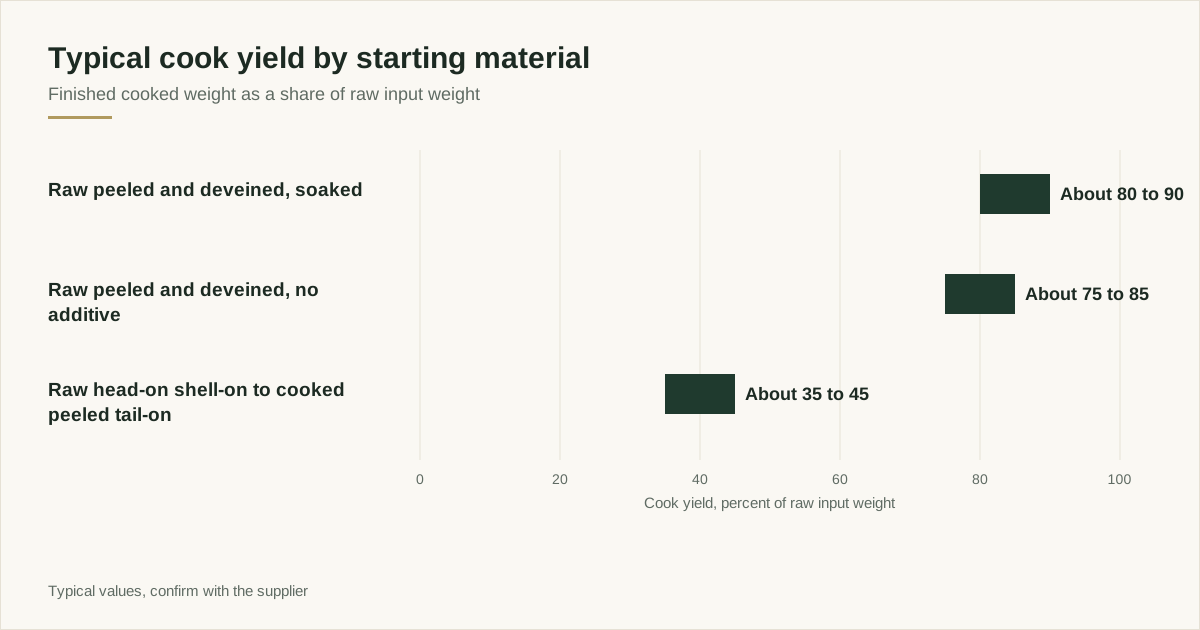
Shrimp lose water in the cooker, and the amount depends on size, species, soak treatment and cook time. A typical raw peeled shrimp loses roughly 10 to 25 percent of its weight in cooking. A shell-on or head-on shrimp loses more once the shell and head are removed afterwards.
| Starting material | Finished product | Typical cook yield | What it means |
|---|---|---|---|
| Raw peeled and deveined, soaked | Cooked peeled | About 80 to 90 percent | Lower loss when moisture retention is used |
| Raw peeled and deveined, no additive | Cooked peeled | About 75 to 85 percent | Higher loss, cleaner label |
| Raw head-on shell-on | Cooked peeled, tail-on | About 35 to 45 percent | Heads, shells and water all leave the weight |
Treat these as typical ranges from plant practice and confirm each figure for your own spec.
The point for a buyer is simple. If a plant quotes cooked shrimp at a price per kilogram of finished product, the cook yield is already inside the price. If a plant quotes at a price per kilogram of raw input, you must multiply by the yield to compare. Always ask which basis the quote uses, and convert every offer to price per kilogram of finished cooked product before you compare.
The guide on glaze, net weight and yield covers the glaze side of the same calculation, and cooked shrimp add a second layer of yield on top of it.
Raw material choices that change cooked quality
Cooked shrimp magnifies defects in the raw material. A shrimp with black spot, soft shell or poor color before cooking comes out with the same defect, and the cooker fixes none of it. Ask the plant how it grades raw shrimp at intake and what rejection rate it applies.
Size uniformity matters more in cooked product than in raw. A mixed batch cooks unevenly: small shrimp overcook while large ones are barely done. Plants avoid this by grading tightly before the cooker, and buyers should expect narrower size ranges for cooked product than for raw. If your spec allows 21/25 with a wider tolerance, the plant may need to run it as two sizes.
Color is the visible result. A good cooked shrimp shows an even orange-pink body with a clean white meat line and no gray patches. Color grades and scores have their own vocabulary, which our guide on shrimp color grades explains.
Why Listeria is the main risk
Cooking kills Listeria monocytogenes. The danger comes afterwards, when cooked shrimp travel through a chiller, onto a belt and into a freezer that handled raw shrimp earlier in the shift. Listeria survives well on wet surfaces and in cold rooms, and it can establish itself in drains, conveyor frames and condensate if sanitation slips.
The standards are strict because the product is ready to eat. The United States treats Listeria monocytogenes as a zero-tolerance organism in ready-to-eat foods. The EU sets criteria for ready-to-eat foods in its microbiological regulation, with a requirement for absence in a test portion at the point where the food leaves the producer for products that can support growth. Check the current text of each regulation for your market, because details such as sample size and shelf life conditions matter.
Controls a buyer should ask a plant to show
A plant that handles cooked shrimp well can show its system on paper. Request these items before you place a first order.
- Zoning: a floor plan that separates raw and cooked areas, with one-way staff and material flow and no shared tools.
- Hygiene steps: foot and hand wash stations at the entry to the cooked zone, dedicated clothing and footwear colors.
- Sanitation records: daily cleaning and disinfection logs with the chemicals and contact times.
- Environmental monitoring: a written swab plan with sampling sites on food contact surfaces, drains and floors, and the last six months of results.
- Finished product testing: the lot release test, the method and the accredited laboratory used.
- Corrective action: what happens after a positive result, including line stop, deep clean and re-test.
Certificates belong to the plant and are verified by an auditor. Do not accept a copy of a certificate as the only evidence. Ask for the audit report summary or the non-conformity list, and read how the plant closed earlier findings. Our guide on certifications by export market explains which schemes each market expects.
Ready to price this spec? Get matched with a shrimp supplier
Packs, glaze and counting for cooked product
Cooked shrimp usually ships as IQF in bags of 1 lb to 5 lb, or in 1 kilogram and 2 kilogram bags inside a master carton, with a glaze that is lighter than for raw product. Because cooked shrimp have already lost water, a heavy glaze would make the net weight gap even larger than on raw shrimp. Ask for the glaze range in the spec and for the deglazed weight method on arrival.
Count per pound also behaves differently. A cooked shrimp weighs less than the raw shrimp it came from, so a cooked 31/40 is a larger raw shrimp than a raw 31/40. Buyers who switch between raw and cooked programmes sometimes find that the cooked shrimp looks smaller on the plate than expected. Agree on the count of the cooked, deglazed product, and let the plant work out the raw size it needs. The guide on size grades and pricing explains how counts are written.
Where cooked shrimp is used
Cooked peeled shrimp goes into salads, sandwiches, pasta dishes and frozen meal kits, where the end user thaws and serves without further cooking. Tail-on cooked shrimp is the standard for shrimp cocktail and party platters, and cooked shell-on shrimp serves cold buffets and some retail packs. Each use pulls the spec in a different direction. Salad programmes ask for small counts and tail-off. Platter programmes ask for large, even, tail-on shrimp with a clean color.
Tell the plant the end use in the first message. A shrimp that suits a pasta line, where the meat is broken or sliced, can be unsuitable for a cocktail ring where every piece must look whole.
Cold chain and storage after the plant
A cooked IQF shrimp that is correct at the plant can still fail after loading. Frozen cooked shrimp should be held at minus 18 degrees Celsius or colder from the freezer to the importer’s cold store. Temperature swings melt the glaze and cause freezer burn, and a cooked shrimp has less moisture reserve than a raw one.
Ask for the container temperature log and compare it to the production date on the carton. Specify the maximum age at arrival, such as 90 days from production, so old stock cannot be shipped to you at the end of a slow season. Mark the batch code on both the carton and the shipping documents so a recall can trace the lot.
What to write in the request
A request for cooked shrimp is longer than a request for raw because it must cover safety evidence as well as size and price.
- Product form: cooked peeled and deveined (tail-on or tail-off) or cooked shell-on.
- Size grade and tolerance, written per pound and per kilogram.
- Price basis: per kilogram of finished cooked product, net of glaze.
- Cook yield figure for the quoted size and treatment.
- Core temperature target at the cooker and chiller exit.
- Listeria controls: zoning plan, swab plan, test results for the last six months.
- Storage and transport: maximum temperature, maximum age at arrival, temperature log.
Next step
Write the seven lines above into one message and add the destination market so the plant knows which Listeria rule applies. Send your spec through the request form and we match you with up to 3 Vietnam processors that run a cooked line. They reply within 24 business hours with prices on finished weight so you can compare offers directly.
Frequently asked questions
What is cook yield in shrimp processing?
Cook yield is the weight of cooked shrimp divided by the weight of raw shrimp that went into the cooker, shown as a percentage. Shrimp lose water in the cooker, so the cooked weight is always lower. A quote for cooked shrimp must say whether the price refers to raw input weight or finished cooked weight.
Why is Listeria a bigger issue for cooked shrimp than for raw shrimp?
Cooked shrimp is ready to eat, so no kitchen step kills bacteria afterwards. Cooking itself destroys Listeria, but the shrimp can pick it up again from surfaces and equipment after the cooker. Plants control this with zoning, sanitation and environmental swabbing, and buyers ask for the records.
Can cooked shrimp be refrozen safely?
Cooked IQF shrimp is frozen once at the plant and should stay frozen until the end user thaws it. Repeated thaw and refreeze cycles damage texture and raise microbial risk. Specify a maximum storage temperature and keep temperature logs for the whole cold chain.
Ready to price this spec?
Send your species, size grade and certificate list. We match you with up to 3 Vietnam processors and reply within 24 business hours.
Get matched with a shrimp supplier