Guides / Specification
Catch weight vs fixed weight shrimp packs: how each is priced, weighed and invoiced
November 3, 2026
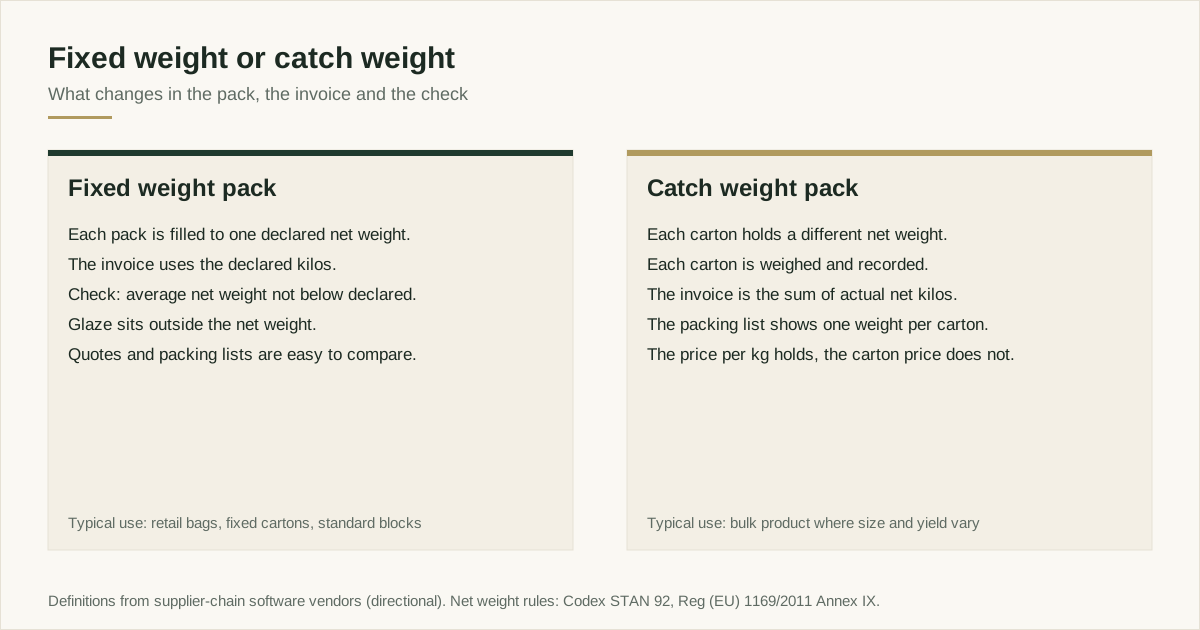
Catch weight shrimp is shrimp sold on the actual net weight of each carton, so every carton is weighed and the invoice is the sum of the weights. Fixed weight shrimp is packed to one declared net weight, such as 2 kg per bag, and invoiced on the declared kilos. Both are priced per kilogram of net shrimp. The choice decides what the packing list shows, who carries the filling error and how you check a container, and it is rarely written into a first request.
What the two terms mean
Catch weight is a term from distribution and inventory systems. Software vendors describe it as the actual measured weight of a unit, which can differ from the nominal weight on the label, with the customer billed on what was weighed. The same sources name seafood, shellfish and shrimp among the usual categories, because natural variation makes a fixed weight hard to hit. These are vendor definitions, so read them as directional: no standard defines catch weight for shrimp, and your contract does.
| Point | Fixed weight pack | Catch weight pack |
|---|---|---|
| Net weight | One declared figure, for example 2 kg | Varies by unit, weighed and recorded |
| Invoice basis | Declared kilos times the price per kg | Sum of the recorded kilos times the price per kg |
| Packing list | Count of units and the declared weight | One weight per carton or a weight list |
| Label | Declared net weight | Weight marked as the destination’s labelling rule requires |
| Who carries the filling error | The buyer, if packs run light | The seller, since the buyer pays for actual kilos |
| Check on arrival | Average net weight against declared | Sum of carton weights against the invoice |
The net weight rules that apply to both
Three rules sit under either choice.
Glaze is outside the net weight. Codex STAN 92-1981 section 6.2 says that where the food has been glazed, the net contents are declared exclusive of the glaze. Regulation (EU) No 1169/2011, Annex IX point 5, says the same: where the food has been glazed, the declared net weight is exclusive of the glaze. So a carton weight on a scale is gross of glaze, and the invoiced figure is the deglazed one. Our guide to glaze, net weight and yield shows how a plant that moves its glaze changes your price per kilo of shrimp.
The Codex lot test is on averages. Codex section 9 says a lot meets the standard when the average net weight of all sample units is not less than the declared weight, provided there is no unreasonable shortage in any individual container. That is a fixed weight test. Under it, one light bag is tolerable if the average holds, and the standard does not define how light is unreasonable, so the order should.
Multi-packs state the unit and the count. EU Annex IX point 3 says that when a prepacked item holds several individual prepacked items of the same quantity, the net quantity is shown as the net quantity of each plus the number of packs. A master carton of ten 1 kg bags is shown that way.
Where the EU prepack scheme fits
Council Directive 76/211/EEC covers prepackages sold in constant nominal quantities, expressed in weight or volume, from 5 g to 10 kg. It asks that the actual contents are not less, on average, than the nominal quantity, sets a tolerable negative error for individual packs and puts the responsibility on the packer or the importer. A bag filled to a constant 1 kg is the kind of pack it describes. A carton whose weight varies from carton to carton is not a constant nominal quantity, so ask the importer’s authority how it expects the weight to be marked on catch weight cartons. The directive is a 1976 text as published on EUR-Lex, so check the consolidated version and national rules.
A worked example with round numbers
The numbers below are an arithmetic illustration, not a market quote. Take a container of 2,000 cartons with a declared net of 10.00 kg each and a price of US$8.00 per kg of deglazed shrimp.
| Case | Net kilos | Value at US$8.00 per kg |
|---|---|---|
| Declared total, 2,000 cartons of 10.00 kg | 20,000 kg | US$160,000 |
| Fixed weight, average actual 9.85 kg | 19,700 kg | US$157,600 |
| Gap if you pay the declared figure | 300 kg, 1.5 percent | US$2,400 |
If the order is fixed weight and you pay the declared total, the 1.5 percent average shortfall costs you US$2,400. The Codex average test would flag it, because the average net weight is below the declared weight. In a catch weight order the invoice would be US$157,600 and no gap would exist, because the invoice follows the scale. The risk moves from the filling line to the scale, so the scale needs a certificate, a recorded ID and a rule for weighing on the packing day.
Ready to price this spec? Get matched with a shrimp supplier
How to choose
Fixed weight suits a retail or foodservice pack that must carry one declared weight on a printed label and fit a distributor’s case rules. Our guide to foodservice portion counts and packs lists the usual bag and carton sizes. Fixed weight also makes quotes from several plants easy to compare, because a carton price is the declared kilos times the kilo price.
Catch weight suits bulk product for further processing, where the buyer cares about kilos and not about a label. It also suits product that is hard to fill to a fixed weight, such as large head-on shrimp or irregular shapes. The cost is paperwork: a weight list with the packing list, and a checking routine on arrival.
A third option is a fixed-weight pack with a minimum, for example a declared 10.00 kg with no carton below 9.95 kg and an average at or above 10.00 kg. It keeps the simple label and caps the shortage. Whichever you choose, name it in the first message so every plant prices the same thing.
What to write into the order
- Pack type: fixed weight or catch weight, and the declared or nominal net per carton.
- Weighing basis: deglazed net weight, glaze limit and the deglazing method, as in Codex STAN 92 section 7.3.
- Invoice basis: declared kilos, or the sum of recorded actual kilos.
- Scale: certificate, recorded ID and the person who weighs on packing day.
- Packing list: one weight per carton for catch weight, and the carton count and declared weight for fixed.
- Tolerance: the lightest single carton and the minimum average for fixed weight.
- Remedy: price adjustment per kilo short, or credit note, and how long you have to claim.
Link the weight check to your inspection plan. A pre-shipment inspection with a written net weight method is the cleanest way to settle a gap before the container leaves.
Next step
Choose the pack type, write the seven lines above into your request and send them through the request form. We match you with up to 3 Vietnam processors, and they reply within 24 business hours. The replies show which plants fill to a fixed weight with a stated minimum and which are used to weighing and listing every carton.
See also: the shrimp count chart: per pound, per kilogram and grams per piece.
Sources
- AEB, what is catch weight management (vendor definition, directional)
- Inecta, catchweight in seafood (vendor article, directional)
- Codex Alimentarius, CODEX STAN 92-1981, quick frozen shrimps or prawns, sections 6.2, 7.3 and 9
- Regulation (EU) No 1169/2011 on food information to consumers, Article 23 and Annex IX (EUR-Lex)
- Council Directive 76/211/EEC on the making-up by weight or volume of certain prepackaged products (EUR-Lex)
Frequently asked questions
What is catch weight in frozen shrimp?
Catch weight means each carton or bag is weighed after packing and the buyer pays for the actual net weight, not a declared one. The weights differ from carton to carton, so the packing list carries one weight per unit. Fixed weight packs are filled to one declared net weight and invoiced on that declared figure.
Which is cheaper, catch weight or fixed weight shrimp?
Neither is cheaper by itself. Both are priced per kilogram of net shrimp. Catch weight removes the give-away on over-filled cartons and the shortage on under-filled ones, because you pay for what is in the box. Fixed weight is simpler to compare and to label. The price difference comes from the plant's filling accuracy, not from the label.
Does glaze count in the net weight?
No. Codex STAN 92 says the declared net contents of glazed shrimp are exclusive of the glaze, and EU Regulation 1169/2011 Annex IX says the same for glazed food. Weigh and invoice on deglazed net weight in both pack types, and write the glaze limit and the deglazing method into the order.
How do I check catch weight cartons on arrival?
Weigh a sample of cartons against the packing list, then deglaze and weigh the shrimp as in the Codex method on a sample. The sum of the carton weights should match the invoice within the tolerance in the order. Use a calibrated scale and record the scale ID, because a scale that reads one percent high moves the invoice by one percent.
Ready to price this spec?
Send your species, size grade and certificate list. We match you with up to 3 Vietnam processors and reply within 24 business hours.
Get matched with a shrimp supplier