Guides / For Processors
How a Vietnam shrimp processor wins a first US importer order: the five checks that come before price
November 12, 2026
A US importer does not choose a Vietnam shrimp plant on price first. Before a first container the buyer runs five checks in a fixed order, and a plant that fails an early one is dropped before anyone looks at a quote: legal registration, food safety records the importer can verify, anti-dumping status, farm-level data for the importer’s own filings and a spec the importer can compare. Having all five ready creates no demand, but it removes the reasons an importer would stop replying. This guide sets out what each check needs from the plant, with the rule behind it, so you can prepare in the right order. It is not legal advice, and a trade lawyer or your industry association should confirm your own position.
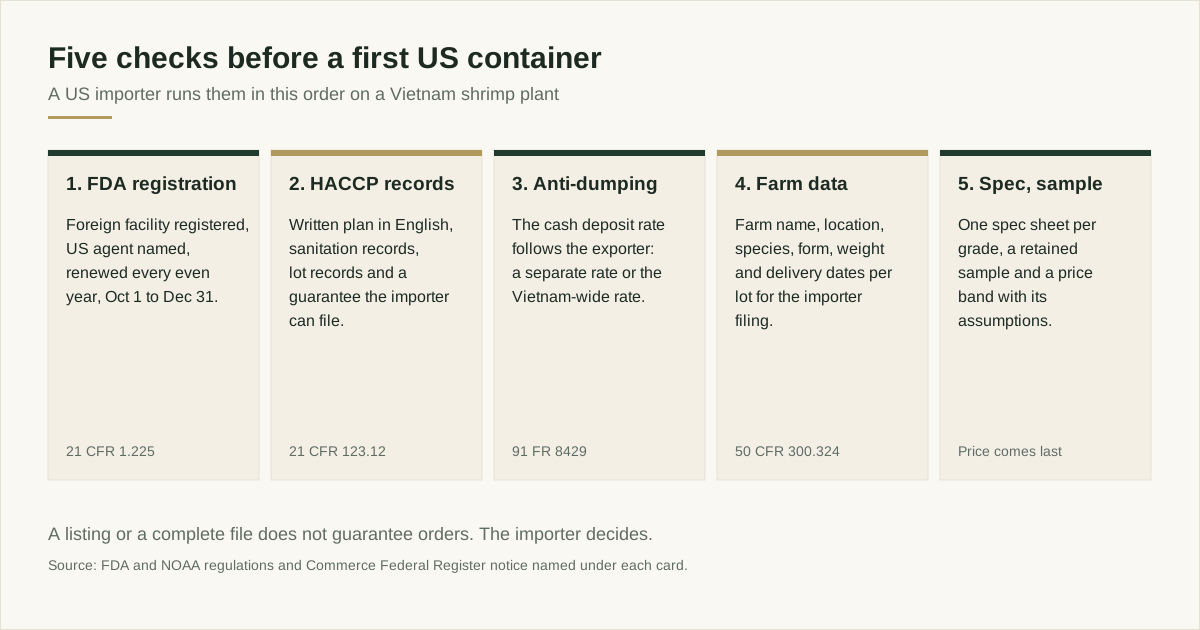
Check 1: FDA registration and a US agent
Section 415 of the Food, Drug, and Cosmetic Act and 21 CFR Subpart H require the owner, operator or agent in charge of a foreign facility that manufactures or processes, packs or holds food for consumption in the United States to register that facility. A few things matter in practice:
- Who is exempt. A foreign facility is exempt when its food is further manufactured or processed, including packaged, by another facility outside the United States, unless that second step is only adding labels. Farms and fishing vessels are also exempt (21 CFR 1.226). A shrimp processing plant that ships to the US is not.
- US agent. A foreign facility designates a US agent who lives or has a place of business in the United States. A mailbox, answering machine or answering service does not qualify. FDA treats what the agent says as what the facility says.
- Renewal. Registration is renewed every other year between 1 October and 31 December of each even-numbered year. 2026 is an even-numbered year, so the current window closes on 31 December 2026.
- Updates. Any change, such as a new operator or US agent, must be updated within 60 days (21 CFR 1.234). Failing to register or renew is a prohibited act under the Act, and FDA treats an unrenewed registration as expired.
An importer will ask for the registration number and check it. An expired or mismatched number ends the conversation. Our guide to certifications by export market lists what else each market asks for.
Check 2: seafood HACCP records the importer can verify
Seafood HACCP is law for US-bound fishery products. 21 CFR Part 123 requires every processor to run a hazard analysis and, where hazards are reasonably likely, hold a written HACCP plan specific to each location and each kind of product (123.6). Sanitation monitoring must cover eight areas, including water safety, food contact surfaces, cross-contamination, hand washing, pest exclusion and employee health, with records (123.11). The plan work must be done by an individual trained in HACCP principles for fish and fishery products or qualified by job experience (123.10).
The importer has its own duty under 123.12. It must either buy from a country with an active agreement with FDA covering the product or have written verification procedures with product specifications and affirmative steps. The steps the rule lists are the same things you can offer:
- the HACCP and sanitation monitoring records for the specific lot
- a lot or continuing certificate from a government inspection authority or a competent third party
- an inspection of your plant by the importer
- a copy of your HACCP plan in English with your written guarantee that the product is processed to Part 123
- periodic product testing, with a written guarantee on file
So a plant that holds an English HACCP plan, a ready set of lot records and a guarantee letter answers the importer’s compliance question in one email. FDA can also list firms on import alerts, and a plant that fails Part 123 is one of the reasons. See our guide to FDA import alerts on shrimp for how a listing works and why an importer will check before it signs.
Check 3: anti-dumping status
Vietnam frozen warmwater shrimp is under a US anti-dumping order, and the cash deposit rate follows the exporter. In the final results of the 2023 to 2024 review (91 FR 8429, 23 February 2026), Commerce found 24 exporters eligible for separate rates and treated 146 companies in that review as part of the Vietnam-wide entity. The cash deposit rules in that notice work like this:
| Exporter type | Cash deposit rate in that notice |
|---|---|
| Separate-rate companies in the review, excluding the two mandatory respondents | 4.58 percent weighted-average dumping margin (4.28 percent after subsidy offsets) |
| The two mandatory respondents | 25.46 percent (after subsidy offsets) |
| Exporters that earlier received a separate rate in a prior segment | Their existing exporter-specific rate |
| Non-Vietnamese exporters without their own rate | The rate of the Vietnamese exporter that supplied them |
| Vietnamese exporters with no separate rate | 25.76 percent, the Vietnam-wide rate |
For a processor the point is practical. A US importer deposits that rate at entry, so a plant on the Vietnam-wide rate costs the importer far more per kilo than a plant with its own rate, and no importer will accept that without asking. Check that your exact company name, including variants, appears under a separate rate in the latest Federal Register notice. The list in the 2026 notice includes alternate spellings for some companies, which shows how much the exact name matters. Rates reset in each annual review, so read the latest notice, and note that this is only the anti-dumping layer. Our guide to Vietnam shrimp tariffs in 2026 covers the whole duty stack an importer pays.
Ready to price this spec? Get matched with a shrimp supplier
Check 4: farm data for the importer’s filings
Shrimp is one of the species in the US Seafood Traceability Program (50 CFR 300.324). At entry the importer of record must file, through ACE, the information on the farm or aquaculture facility that produced the shrimp: the farm or aquaculture facility name or an aggregated harvest report, the species, the product form, the quantity or weight, the area and location of the farm and the date and entity of first delivery. The importer must also hold an NMFS-issued trade permit number and keep these records and chain-of-custody records for 2 years.
Prior notice is a separate filing by the importer or broker. It names the manufacturer and either its FDA registration number, city and country or its full address, and it must be confirmed no less than 8 hours before arrival by water (21 CFR 1.279 and 1.281).
| What the importer or broker files | What the plant must supply per lot |
|---|---|
| Prior notice, manufacturer entry | Plant name, address, FDA registration number |
| Seafood traceability filing | Farm or aquaculture facility names, location, species, product form, quantities, delivery dates |
| Chain-of-custody records, 2 years | Delivery notes from farm to plant, production records, loading records |
If your farm records sit with buyers’ agents or collectors, fix that first. Our guide to pond-to-plant traceability shows how a lot trace works.
Check 5: a spec, a sample and a price
Only after the first four does the importer compare plants on grade, pack and price. Prepare:
- A spec sheet in English. Put species, form, count, glaze, net weight basis, additives and packing in one document.
- A sample the buyer can test. Our buyer-side guide to what to request before a container shows what the importer will measure, so you can pre-check it.
- A price band with its assumptions, as set out in our guide to what importers ask Vietnam processors first, and a payment structure from the first order timeline.
- An open door for pre-shipment inspection, which a first-time buyer expects and our guide to pre-shipment inspection explains.
What to prepare this month
- Confirm FDA registration status and that your 2026 renewal is done, and that your US agent details are current.
- Collect the English HACCP plan, a recent set of lot records and a signed guarantee template.
- Read the latest anti-dumping notice and confirm your company name and rate status.
- Build a per-lot farm record: farm names, locations, species, delivery dates.
- Write the spec sheet and keep a retained sample from each production lot.
Importers read the same gates in our guide to importing frozen shrimp from Vietnam.
Next step
If you export shrimp already or are preparing to, register your plant with the grades, the FDA registration number and the certificates you actually hold. We match buyers’ requests to plants on the facts you list. A listing does not guarantee orders, and the importer decides, so keep the five checks current.
See also: US shrimp import requirements, as of October 2026.
Sources
- 21 CFR Part 1, Subpart H, registration of food facilities (eCFR), sections 1.225, 1.226, 1.227, 1.231 to 1.234 and 1.241
- 21 CFR Part 1, Subpart I, prior notice of imported food (eCFR), sections 1.279 and 1.281
- 21 CFR Part 123, fish and fishery products (eCFR), sections 123.6, 123.10, 123.11 and 123.12
- 50 CFR 300.324, Seafood Traceability Program (eCFR)
- Commerce, final results of the 2023 to 2024 anti-dumping review of frozen warmwater shrimp from Vietnam, 91 FR 8429 (23 February 2026)
Frequently asked questions
Does a Vietnam shrimp plant need FDA registration to ship to the US?
Yes. A foreign facility that manufactures, processes, packs or holds food for US consumption must register with FDA and name a US agent who has a physical presence in the United States. Registration is renewed every two years between 1 October and 31 December of even-numbered years, and changes such as a new US agent must be updated within 60 days.
Who submits prior notice for a shrimp container?
Normally the importer or its customs broker submits it, not the plant. The plant supplies the facts, mainly its name, address and FDA registration number as the manufacturer. For a sea shipment the notice must be confirmed by FDA no less than 8 hours before the vessel arrives at the US port.
How much anti-dumping duty applies to a plant without its own rate?
In the final results published on 23 February 2026, Commerce set 25.76 percent for exporters that have not been found entitled to a separate rate, the Vietnam-wide entity. Plants in that review with a separate rate carried 4.58 percent, or 4.28 percent after subsidy offsets. Rates change each review, so confirm the current notice.
What farm data does a US importer need from the plant?
For shrimp the importer must report the farm or aquaculture facility name or an aggregated harvest report, the species, product form, quantity, farm location and dates of delivery to the processor, and keep records for 2 years. The plant should hold these per lot, so the importer can file them at entry.
Ready to price this spec?
Send your species, size grade and certificate list. We match you with up to 3 Vietnam processors and reply within 24 business hours.
Get matched with a shrimp supplier