Guides / Choosing a Supplier
Shrimp disease and Vietnam supply: how white spot, AHPND and EHP reach your size mix and your quote
November 11, 2026
Three diseases decide most of the supply risk in Vietnam shrimp: white spot syndrome virus (WSSV), acute hepatopancreatic necrosis disease (AHPND) and the parasite EHP. They hit a crop in different ways. WSSV and AHPND wipe out ponds, so supply falls. EHP does not kill much, but it slows growth and spreads the sizes out, so the same pond yields smaller, more uneven shrimp. A buyer sees all three in the quote as a change in available sizes, a change in price and sometimes a change in quality, not as the disease itself. This guide sets out what each disease does, what the public record says about Vietnam and what to ask a plant before you commit a container.
The three diseases side by side
| White spot (WSSV) | AHPND | EHP | |
|---|---|---|---|
| Agent | A virus (white spot syndrome virus) | Strains of Vibrio parahaemolyticus carrying a toxin plasmid | A microsporidian parasite |
| Main effect | High mortality in penaeid shrimp | Sudden mass mortality, up to 100 percent | Slow growth, uneven sizes, high feed conversion |
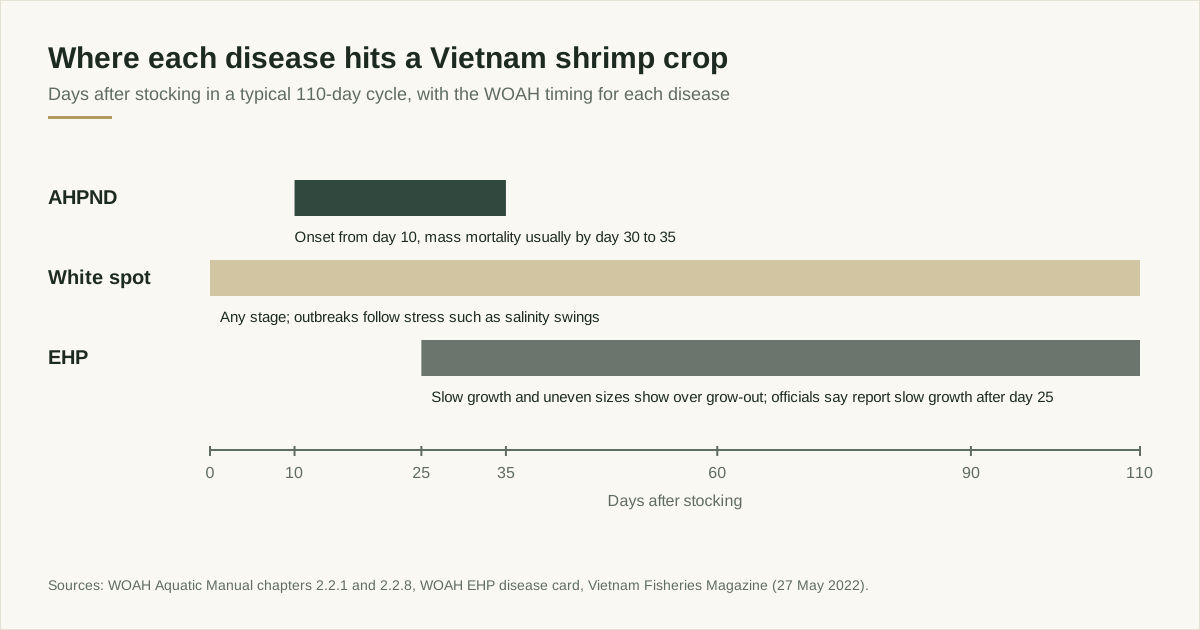
| Timing in the crop | Any life stage; outbreaks follow stress such as salinity swings | Usually within 30 to 35 days of stocking, as early as 10 days | Builds through grow-out; early signs are subtle |
| WOAH status | Listed disease | Listed disease | Not listed; treated as an emerging disease |
| Vaccine or cure | No consistently effective vaccine | None available | No specific treatment |
| Effect on supply | Lost crops, lost volume | Lost crops, lost volume, soft shells in affected shrimp | Smaller sizes, more variation, early harvests |
Sources for each row are the WOAH Aquatic Manual chapters on WSSV and AHPND and the WOAH disease card for EHP, listed below.
What each disease does to a crop
White spot. The WOAH manual says all penaeid shrimp species are highly susceptible, and infection often results in high mortality. Prevalence runs from under 1 percent in wild populations to up to 100 percent in captive ones. White spots in the shell are the best-known sign, yet the manual warns they are not a reliable diagnostic, since stress or bacterial disease can cause them and dying shrimp may show few. Transmission can come from apparently healthy animals. Outbreaks are linked to stressors such as rapid salinity change, and average water temperatures of 18 to 30 degrees Celsius favor them. A 2018 review of Asian shrimp disease losses puts typical stock loss from an infection at 80 to 100 percent.
AHPND. WOAH describes sudden mass mortality, up to 100 percent, usually within 30 to 35 days of stocking, with onset as early as 10 days. The disease was first reported in Asia in 2010. Low salinity below 20 ppt seems to reduce it, and it peaks in the hot dry season from April to July. Affected shrimp can show a pale hepatopancreas and soft shells, which is where it touches quality: our guide to soft shell, broken and dehydrated frozen shrimp shows how to grade for it.
EHP. The WOAH disease card says EHP does not cause significant mortality but affects production through growth retardation and a possible association with white feces syndrome. Infected ponds show different growth rates, uneven individual sizes and a high feed conversion ratio. WOAH treats infection with EHP as meeting its definition of an emerging disease, lists Vietnam among the countries that reported it and lists no zoonotic importance. It also notes that EHP raises susceptibility to the bacteria that cause AHPND. WOAH’s Asia report form for Vietnam lists it among the diseases that are not WOAH-listed.
What the public record says about Vietnam
No public national series gives crop losses by disease, so any exact “percent lost” figure you see in a sales message needs a named source. The records I could open are partial:
- Mekong Delta, 2014. A review by Shinn and colleagues reported that 8.72 percent of black tiger pond area and 32.48 percent of whiteleg pond area in the key Mekong provinces were affected by disease. The authors call their Mekong loss estimates for 2015 assumption-based, and note that another source put white spot losses far higher than their own figure, which shows how rough such numbers are.
- May 2022. At a ministry workshop reported by Vietnam Fisheries Magazine, officials said 10,814 hectares of brackish-water shrimp ponds were damaged, 2.2 times the previous year and 2.1 percent of the country’s shrimp farms. White spot, AHPND and EHP were all found. Processors told the magazine they worried about raw material shortage. A company director quoted in the article tied the early outbreak to day-night temperature swings and heavy off-season rain that lowered salinity.
- Official guidance. A provincial animal health official quoted in the article advises farmers to report unusual mortality or slow growth after 25 days of stocking, filter water, sterilize equipment and never move shrimp between ponds. EHP has no specific treatment, and antibiotics are not effective against it.
These are snapshots, not a trend. For the current season, ask the plant and check the ministry’s aquatic animal health reports.
Ready to price this spec? Get matched with a shrimp supplier
How it reaches your quote
Fewer large shrimp. A disease that slows growth or forces early harvest moves a pond’s output down the size ladder. Shinn’s worked example for Thailand assumes a normal 110-day crop reaches about 18 g and yields 12 tonnes per hectare, while an EHP-hit pond may stall near 12 g and yield 9 tonnes. As arithmetic, 18 g is about 25 whole shrimp per pound and 12 g is about 38. Trade counts use headless weight, so the grades differ, but the direction is clear: a size 21/25 request gets harder to fill. Our guide to size grades and pricing shows what a step in grade does to the price.
Price pressure. The same review notes that disease causes large national income losses even though supply shortage raises prices. For a buyer it means a scarce size costs more, and the plant passes that on when raw material tightens. See what moves the FOB quote.
Quality and residue risk. A plant short of raw material may take smaller or weaker shrimp. Check for soft shell and dehydration on every lot. Because EHP does not respond to antibiotics, ask what a farm used on an ailing pond, and see our guide to antibiotic residue testing for EU and US entry.
Market access. The WOAH manual notes that viable WSSV has been found in frozen commodity shrimp imported to Australia from Southeast Asia. Importers in disease-free countries can set testing conditions on raw product, so check the destination before you promise a lot. Our guide to shrimp for Korea and Australia covers the rules, and your broker has the current ones.
Questions to put to a plant
- Which farms or districts supply your raw material for my lot, and at what pond age were they harvested?
- Were the post-larvae tested for EHP and white spot? WOAH encourages EHP-free broodstock and post-larvae.
- What is the size spread in a harvest-day sample? Ask for 100 shrimp weighed individually and the coefficient of variation. WOAH names high size variation as a field sign of EHP.
- Did any supplying farm report mortality or slow growth this crop, and how was the crop treated?
- How does your raw material source change in the April to July dry season and after heavy rain?
- What happens to my order if the sizes I asked for are short: substitution, delay or price change?
Put the answers to 5 and 6 in the contract. Our guide to pond-to-plant traceability shows the farm-level records that make questions 1 and 4 answerable. If you compare origins, Vietnam against India and Ecuador puts disease exposure beside price and lead time, and vannamei against black tiger covers the species side.
How supply risk reaches the quote is one part of our guide to the Vietnam shrimp export price.
Next step
Write the size range, the acceptable substitution and the farm-level questions above into your request and send them through the request form. We match you with up to 3 Vietnam processors, and they reply within 24 business hours. Compare how each plant answers on farm source and size spread, since the plants that know their farms answer in specifics.
See also: the vannamei shrimp reference: biology, counts and forms.
Sources
- WOAH Aquatic Manual 2023, Chapter 2.2.8, infection with white spot syndrome virus
- WOAH Aquatic Manual 2023, Chapter 2.2.1, acute hepatopancreatic necrosis disease
- WOAH disease card, infection with Enterocytozoon hepatopenaei (EHP), September 2022
- WOAH Asia, aquatic animal disease report for Vietnam, 2024
- Shinn et al., Asian Shrimp Production and the Economic Costs of Disease, Asian Fisheries Science 31S (2018)
- Vietnam Fisheries Magazine, Shrimp diseases remain a major concern, 27 May 2022 (trade press, directional)
Frequently asked questions
Can white spot virus survive in frozen shrimp?
Yes. The WOAH Aquatic Manual reports viable white spot virus in frozen commodity shrimp imported to Australia from Southeast Asia, and adds that repeated freeze-thaw cycles might inactivate it. It is a crustacean disease, so the cost to a buyer is trade conditions and lost supply. Ask the plant for its testing and check your market's import rules.
Which shrimp disease is the biggest problem in Vietnam now?
No public national series ranks them by loss. Provincial officials reported white spot, AHPND and EHP together in 2022, and a Bac Lieu farmer told trade press that EHP was the biggest worry because it slows growth and has no specific treatment. Ask each plant which farms it buys from and what those farms saw this season.
Why does EHP matter if it does not kill shrimp?
EHP is a parasite that slows growth and makes sizes uneven, so a pond yields smaller and more variable shrimp at the same cost. The WOAH disease card says it does not cause significant mortality, and also that it raises susceptibility to AHPND. The loss shows up in your size mix, not in a headline die-off.
When is disease risk highest in Vietnam?
It varies by disease and region. WOAH notes that AHPND peaks in the hot dry season from April to July and that average water temperatures of 18 to 30 degrees Celsius favor white spot. A company director quoted in 2022 linked an EHP surge to heavy rain that lowered salinity. Ask a plant how its raw material changes through the year.
Ready to price this spec?
Send your species, size grade and certificate list. We match you with up to 3 Vietnam processors and reply within 24 business hours.
Get matched with a shrimp supplier