Guides / Choosing a Supplier
Vannamei or black tiger from Vietnam: which species fits your spec and your budget
October 28, 2026
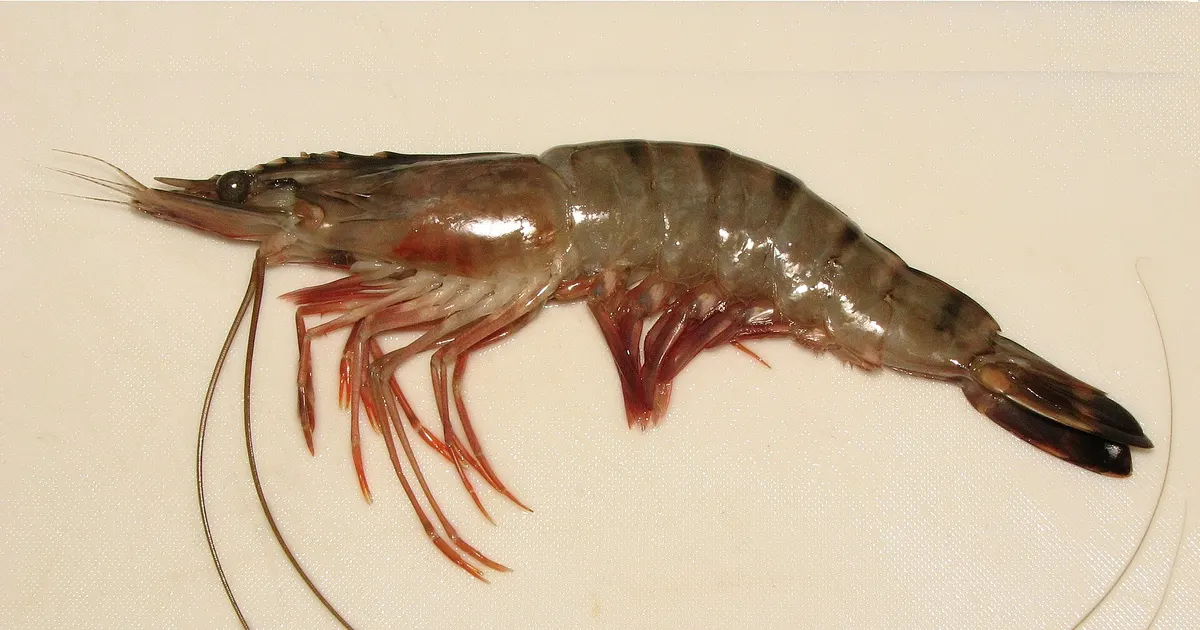
A buyer who asks a Vietnam plant for “shrimp” gets one of two answers: vannamei or black tiger. The two species share a country and a freezer, and almost nothing else. They grow in different systems, reach different sizes, taste different and sell at different prices.
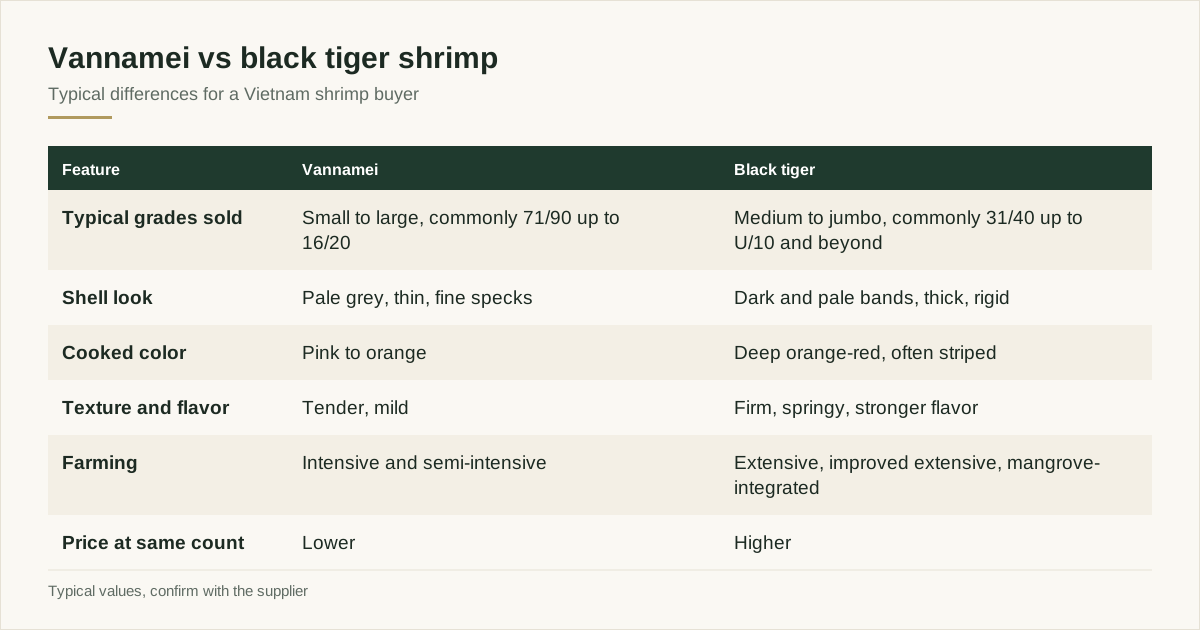
This guide compares them on the points a buyer actually decides on, so the first request names the right species.
The two species in one paragraph each
Vannamei is the whiteleg shrimp, Litopenaeus vannamei, also sold as Pacific white shrimp. It is native to the Pacific coast of the Americas and was introduced to Asia for farming. It now dominates Vietnam’s farmed shrimp volume, because it grows quickly, tolerates dense stocking and comes from broodstock bred for disease resistance. Its meat is mild and tender, and its shell is pale and thin.
Black tiger is Penaeus monodon, the giant tiger prawn, a species native to the Indo-Pacific. It is a larger shrimp with dark banded shells and a firm, slightly sweeter bite. Vietnam farms it mainly in extensive and improved-extensive ponds and in mangrove-integrated systems, with lower stocking density than vannamei. It supports a premium market in Japan, Korea and parts of Europe.
How they compare
| Feature | Vannamei | Black tiger |
|---|---|---|
| Typical grades sold | Small to large, commonly 71/90 up to 16/20 | Medium to jumbo, commonly 31/40 up to U/10 and beyond |
| Shell look | Pale grey, thin, fine specks | Dark and pale bands, thick, rigid |
| Cooked color | Pink to orange | Deep orange-red, often with visible stripes |
| Texture | Tender, mild | Firm, springy |
| Flavor | Mild and slightly sweet | Stronger, more marked sweetness |
| Farming | Intensive and semi-intensive | Extensive, improved extensive, mangrove-integrated |
| Supply | Large and steady | Smaller and more variable |
| Price at same count | Lower | Higher |
Ranges are typical and vary by plant, season and farm. Ask each plant which counts it runs in each species.
Size range and what it means for specs
Size is the clearest difference. A vannamei in the 16/20 range is a large shrimp for the species, and the volume tapers off above it. A black tiger of the same count is average, and the species continues up to counts that vannamei rarely reaches. Buyers who want a large centre-plate shrimp for restaurants or a jumbo grill shrimp for retail often find that only black tiger delivers the size.
At small and mid sizes, 31/40 to 71/90, vannamei dominates. Salad, pasta, breaded and value-add programmes lean on small whiteleg because supply is large and the price fits the product. Our guide on Vietnam shrimp size grades and pricing explains how the count is written and how each step changes the cost.
Taste and texture
Taste differences are real but subtle, and they depend on preparation. Black tiger has a firmer, springier bite and a flavor that many chefs describe as more pronounced. Vannamei cooks up tender, with a mild flavor that takes sauces well.
For dishes where the shrimp stands alone, such as grilled shrimp, tempura or a cocktail, black tiger often wins on bite and presence. For dishes where the shrimp mixes with other ingredients, such as fried rice, dumplings, curry and pasta, vannamei does the job at a lower cost. A short cooking test settles the matter faster than any description. Ask for sample cartons of both species at the same count, cook them the way your customer does and compare.
Price and what drives the gap
Two factors set the price gap. The first is farming economics. Vannamei grows in a short crop cycle at high density with predictable survival, so a farm produces more kilograms per hectare and the plant can plan supply. Black tiger needs lower density, takes longer to reach large sizes and carries a higher risk of crop loss, which raises the cost per kilogram.
The second is demand. Japan, Korea and some premium retailers pay for black tiger’s size and color, and that demand holds the price up even when supply is steady. The gap narrows when black tiger supply is high and widens when it is short.
Do not compare per-kilogram prices at different counts. A black tiger at a larger count may cost more per kilogram and still cost less per portion than a pair of smaller shrimp. Compare the cost per piece or per portion of the finished plate. Also confirm that glaze and net weight are the same in both quotes, using the method in our guide on glaze, net weight and yield.
Supply, seasonality and lead time
Vannamei supply runs most of the year in the delta, with peaks tied to the crop cycles, and plants hold a steady flow of raw material. Black tiger supply is more seasonal and less predictable. Large sizes may be tight in some months, and a plant may need advance notice to build a lot.
Share your annual volume and your delivery calendar early. A plant that knows you need a fixed volume of large black tiger each quarter can plan with its farm base. A one-off order for the same product in a tight month may take longer or cost more. Our guide on payment terms and the first order timeline explains how lead time and deposit terms fit together.
Processing and yield differences
Species changes yield. Black tiger has a larger head relative to body weight and a thicker shell, so the yield from head-on to peeled tail meat is lower than vannamei at the same head-on weight. A buyer who compares head-on offers should convert to peeled weight to see the true cost of the edible part.
Processing also behaves differently. Black tiger’s rigid shell makes peeling slower, and its firm meat holds shape well in stretching for nobashi and in butterfly cuts. Vannamei peels faster and suits high-volume lines. Color after cooking differs too, and black tiger often needs less correction to reach a deep red. The guide on shrimp processing forms shows how yield changes from head-on to value-add forms.
Ready to price this spec? Get matched with a shrimp supplier
Farming systems and what a buyer can say about them
Vannamei farms in the delta range from semi-intensive ponds to highly intensive systems with aeration, biofloc or lined ponds, and the system affects both the cost and the story a retailer can tell. Black tiger farms often run lower density in earthen ponds and in mangrove-integrated systems, where shrimp feed on natural food as well as pellets. Some retail customers pay for that story, and some certification schemes recognise it.
A buyer should avoid claims the plant cannot document. If a customer wants the words organic or mangrove-friendly on the label, ask the plant for the certificate of the farm or the scheme, and verify it with the issuer. A farm system is a fact about a pond, and the plant must be able to trace the shrimp in your carton to such a pond. Our guide on farming organic mangrove shrimp in Ca Mau covers how that system works and what the paperwork shows.
Disease risk and supply stability
Both species face disease risk, and the way it shows up differs. Vannamei farming concentrates a lot of animals in a small area, so an outbreak can remove a large share of a crop quickly, and farms invest in biosecurity and pathogen-free post-larvae to limit it. Black tiger farming spreads the risk through lower density, but survival rates tend to be lower and more variable, and large sizes depend on crops that run longer.
For a buyer, the practical point is supply stability. A plant that draws vannamei from many farms across several provinces can absorb a local outbreak. A plant that depends on a small group of tiger farms may struggle to fill a large order in a bad season. Ask each plant how many farms feed the species you want and how it covers a shortfall, and plan a buffer in your order calendar.
Which species suits which programme
| Programme | Usual species | Reason |
|---|---|---|
| Retail bags, mainstream | Vannamei | Price, size uniformity, steady supply |
| Breaded and value-add | Vannamei | Low cost, small to mid sizes |
| Foodservice, mid-price | Vannamei | Consistent counts at fair price |
| Premium retail and restaurant centre plate | Black tiger, large vannamei | Size, bite, color |
| Japan tempura and sushi | Black tiger or large vannamei | Shape, length, color |
| Premium cooked platters | Both | Depends on customer’s color and size target |
Treat the table as a starting point. Some Japan programmes run on large vannamei because supply and price are easier to manage, and some mainstream programmes add black tiger as a premium line.
Labeling and species declaration
Declare the species on the carton, the specification sheet and the invoice. Use the full common name and the Latin name, for example whiteleg shrimp (Litopenaeus vannamei) or giant tiger prawn (Penaeus monodon). Many markets require the species name on retail labels, and a mislabeled species is a compliance problem. Ask the plant to confirm that the raw material is the declared species, since mixed lots occur when plants buy from collectors who handle both.
Testing both species before you commit
A side-by-side trial removes guesswork. Ask a plant for sample cartons of each species at the same count and form, and run the same tests on both. Thaw under controlled conditions, weigh the deglazed shrimp and count the pieces per kilogram. Cook the shrimp the way your customer does and compare bite, flavor and color. Peel a small sample to check the yield from head-on or shell-on to meat.
Score the results on a simple sheet and share it with your customer or your chef. The numbers on yield and cost per portion often decide the matter, and the cook test shows whether the premium for black tiger shows up on the plate. Keep the sheet in the supplier file, since a second trial next season will show whether the plants hold their quality.
What to write in the request
- Species: vannamei, black tiger or a request for both prices.
- Size grade per pound and per kilogram, with a tolerance.
- Processing form and treatment, for example headless shell-on, peeled and deveined tail-on.
- Net weight basis, glaze and any soaking policy.
- Farming system if your customer asks, such as mangrove-integrated for tiger.
- Annual volume and delivery calendar, so the plant can plan raw material.
Next step
If you are unsure which species to specify, ask for both at the same count and compare cooked samples. Send your spec through the request form and we match you with up to 3 Vietnam processors that run the species you name. They reply within 24 business hours, and you can compare price per portion, not just per kilogram.
See also: the vannamei shrimp reference: biology, counts and forms.
Frequently asked questions
Which is cheaper, vannamei or black tiger shrimp?
At the same count per pound, vannamei is usually cheaper because it grows faster, tolerates higher stocking density and has a more predictable supply. Black tiger commands a premium for its size range, firm bite and strong color. The gap changes with season, raw material supply and grade, so ask for both prices in the same request.
Can I tell the species apart in a frozen carton?
Usually yes. Black tiger has dark and light bands across the shell and body and a thicker, more rigid shell. Vannamei is pale grey to translucent with fine dark specks and a thinner shell. Peeled shrimp look closer, so ask for species on the carton label and in the product specification.
Which species is better for cooked shrimp rings?
Both work. Vannamei is the usual choice for volume and uniform size, while black tiger gives a larger, deeper-colored shrimp for premium platters. Choose by the color and size your customer expects on the plate, and test a cooked sample from each.
Ready to price this spec?
Send your species, size grade and certificate list. We match you with up to 3 Vietnam processors and reply within 24 business hours.
Get matched with a shrimp supplier