Guides / Choosing a Supplier
Private label frozen shrimp: how supermarket brands develop, audit and launch a Vietnam programme
October 17, 2026
A supermarket shopper reaches for a bag of frozen shrimp with the store’s own name on it and expects the same count, color and bite every time. Behind that bag sits a development process in which the retailer sets a spec, a plant proves it can meet it and both sides agree on packaging, audits and a calendar.
This guide walks through the steps for a private label shrimp programme with a Vietnam plant and the choices that decide cost and risk.
What private label means for a shrimp plant
Private label means the plant makes the product to the retailer’s specification and packs it under the retailer’s brand. The plant does not sell the item under its own name. Plants often run several private label items for different customers in parallel, with each item having its own spec, bag and carton.
The brand owner controls the spec, the packaging design and the claims. The plant controls production, quality systems and the quality of raw material. The relationship works well when both parties know where the line between them sits and put it in writing.
Start with the spec
A private label spec for shrimp usually covers the following sections.
| Section | Typical content |
|---|---|
| Product | Species, form, size grade with tight range, tail rule, raw or cooked |
| Treatment | Additive policy, soaking, anti-melanosis agents |
| Net weight | Glaze limit, net weight per bag and per carton |
| Quality | Color chart, defect limits, black spot, soft shell, broken pieces |
| Microbiology and residues | Limits, test methods, frequency, accredited laboratory |
| Pack | Bag material, size, closure, carton dimensions, pallet pattern |
| Labeling | Name, ingredients, allergens, origin, production method, storage and cooking |
| Shelf life | Minimum remaining life at arrival and maximum age |
| Documents | Specification sheet, certificates, test reports |
Write the spec in measurable terms, with photos for color and defects. Our guides on size grades and pricing, glaze, net weight and yield and frozen shrimp quality defects provide the building blocks.
Choose the formats and the range
Retailers usually run a small range at first. A common starting set includes a raw peeled and deveined tail-on bag in one or two sizes, a raw shell-on or headless bag, a cooked peeled bag and, if the brand wants a seasonal item, a cooked ring. Each additional size and form raises the minimum order and the packaging cost.
Decide which items carry the volume and which are tests. Start with the items where the plant is strongest, and add more once the first ones run well. The guide on shrimp processing forms explains the forms and their yield.
Packaging and artwork
Packaging is the longest part of the timeline. The brand sends artwork to the packaging supplier, which prints a proof. The brand approves the proof, and the supplier runs the print. Each size and each language needs its own artwork, and printed film often has a minimum run per design.
Choose the bag format with the cold chain in mind. A bag for frozen shrimp needs a barrier film, a strong seal and a clear window or print that shows the product. Check the pack on a full freezing and thaw cycle, and run a drop and stacking test on the carton.
Agree on ownership in the contract. The brand owns its artwork and its barcode numbers. The plant prints to the artwork, keeps leftover packaging in a controlled area and does not use it for other customers. The contract should say what happens to leftover packaging if the programme ends.
Label rules and claims
Retail labels must meet the rules of the destination market, and shrimp has specific requirements.
- EU. For prepacked fishery and aquaculture products, the label must show the commercial designation and the scientific name, the production method such as farmed or caught, the area or country of farming and whether the product has been defrosted. It must also show the usual items such as ingredients, allergens, net quantity, durability date and the operator’s name and address.
- United States. The label shows the product name, net quantity, ingredients with an allergen statement, the name and place of business and the country of origin. For fish and shellfish, country of origin labeling also requires a statement of farm-raised or wild-caught.
- Other markets. Japan, Korea and Australia each have their own rules for naming, additives and origin.
Claims such as sustainably farmed, ASC or BAP need a valid chain of custody and a license to use the logo. Certificates belong to the plant and the certification body, so a buyer should verify them with the issuer and confirm that the certificate covers the lot. Our guide on shrimp certifications by export market explains the schemes.
Check the current label rules with your importer or a regulatory adviser before you finalize artwork.
Plant approval and audits
Retailers approve plants before they place a first order. A typical approval has three parts.
- Documents. The plant sends its food safety certificate, its HACCP plan, its traceability procedure, its residue testing plan and its allergen controls.
- Audit. The retailer’s technical team or a third-party auditor visits the plant, checks the facility and reviews records.
- Trial. The plant produces a trial run to the spec, and the retailer inspects and tests the product.
Retailers often require a recognised food safety scheme and a social compliance audit. The certificates belong to the plant, and the retailer verifies them with the issuer. Plants that already hold these and pass retailer audits can launch faster. Plants without them need time to prepare, and a buyer should ask about status early.
Minimums, price and who carries the stock
Private label programmes have several cost layers: the shrimp, the processing, the packaging, the carton, the freight and any royalties or fees. Each layer has minimums. The bag has a minimum print run, the carton has a minimum, and the plant has a minimum production run per item.
Ask each plant three questions about commitment. What is the minimum per item for the first order and for repeat orders? Who carries the risk of leftover packaging if the programme changes? How long will the plant hold price once the programme starts, and how does it adjust for raw material swings?
A phased plan helps. Start with a trial order large enough to prove the item, then agree on a forecast for the season. The guide on payment terms and the first order timeline explains how deposits, balances and documents fit around a first order.
Ready to price this spec? Get matched with a shrimp supplier
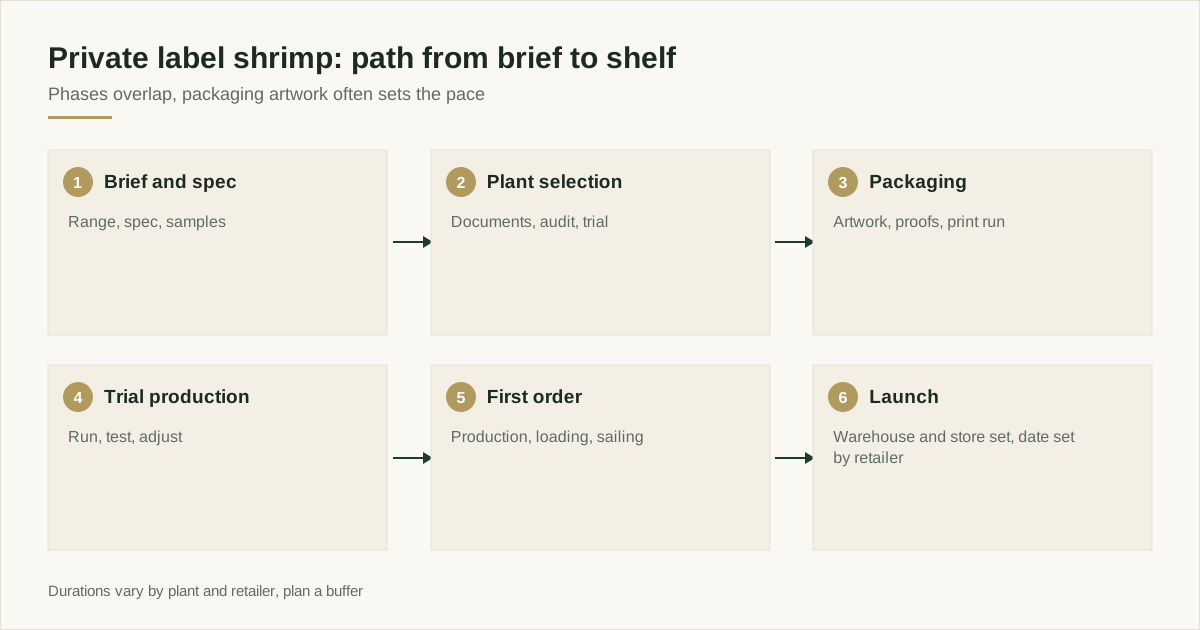
Timeline from brief to shelf
| Phase | Typical duration | Main tasks |
|---|---|---|
| Brief and spec | Several weeks | Range, spec, samples |
| Plant selection | Several weeks | Documents, audit, trial |
| Packaging | Several weeks, in parallel | Artwork, proofs, print run |
| Trial production | A few weeks | Run, test, adjust |
| First order and shipping | Several weeks | Production, loading, sailing |
| Launch | Set by retailer | Warehouse, store set |
The durations are indicative. A plan that depends on one tight step, such as an audit slot, needs a buffer. Start with the date the product must reach the store, and count back.
Pricing structure and how to review it
Private label price quotes work best when the plant breaks the price into parts: raw material, processing, packaging and freight. A breakdown helps the retailer review the quote each season and separate raw material changes from other costs. It also helps in negotiation, since the retailer can see where savings are possible, such as a simpler bag or a larger carton.
Review the price on a fixed schedule, for example each season or each half year, and tie the review to a stated index or a stated formula for raw material. Without a rule, each review turns into a negotiation from scratch. With a rule, both sides can plan.
Exit terms and risk sharing
A private label programme can end for many reasons: a change in the retailer’s range, a quality failure or a supply problem. Agree on the exit terms early. State how long the plant keeps packaging stock, who pays for leftover film and cartons, how long notice must be and what happens to finished stock in transit.
Also agree on dual sourcing. Some retailers qualify two plants for each item so that a problem at one does not stop the programme. A plant that accepts this must still protect the retailer’s artwork and spec. Write the rule on how the volume splits and how the retailer approves a second plant.
Quality control during the programme
A private label programme runs for years, so quality control must be systematic. Set up a routine of lot reports, retained samples and periodic audits. Each shipment should arrive with the lot documents, and the retailer should test a share of lots on arrival for count, glaze, defects and residues.
Agree on a complaint process: how fast the retailer reports a problem, which evidence it sends and how the plant responds. Include a recall procedure with contacts on both sides. Our guide on antibiotic residue testing and the guide on shrimp traceability in the Mekong Delta describe the records that make a recall workable.
Supplier relationship and communication
A private label programme works best when both sides name one contact for quality and one for commercial matters. The quality contact handles specs, test reports and claims. The commercial contact handles prices, volumes and calendars. Hold a short review each quarter, with data on shipments, defects, claims and forecast. Share the retailer’s sales data when you can, since the plant can plan raw material better when it sees the real demand.
Visits help. A visit by the retailer’s technical team to the plant, and a visit by the plant to the retailer’s warehouse or stores, build trust and show each side the other’s constraints. If travel is hard, use video tours and shared dashboards for lot data and temperature logs.
What to write in the request
- Range: items, species, forms, sizes and pack formats.
- Spec: count range, glaze, defects, color chart and treatment.
- Packaging: bag type, artwork status, who owns the film and barcodes.
- Label: market, required statements and claims.
- Audits: scheme and retailer audit requirements.
- Volume: first order, annual forecast and minimum per item.
- Calendar: launch date, trial date and artwork deadline.
Next step
Write the range and the launch date first, then the spec. Send your spec through the request form and we match you with up to 3 Vietnam processors that run private label programmes. They reply within 24 business hours, and you can compare their minimums, audit status and development calendars side by side.
Frequently asked questions
How long does private label shrimp development take?
Plan on several months from first spec to first shipment. Spec and samples take weeks, packaging artwork and printing add weeks, plant approval and audits can take longer, and a trial run comes before the first full order. A buyer who needs a spring launch should start in the autumn before.
What minimum order do plants ask for on private label?
Plants set minimums by item and by pack, since each printed bag and each size grade needs its own run. The minimum depends on the packaging supplier and the plant's line. Ask each plant for its minimum per item and per container and plan the range around it.
Who owns the packaging artwork and barcode?
The brand owner owns its artwork and its barcode numbers. The plant prints to the artwork and uses the barcode the brand provides. Agree in the contract that the plant will not use the brand's packaging for other customers and will destroy or return leftover stock on request.
Ready to price this spec?
Send your species, size grade and certificate list. We match you with up to 3 Vietnam processors and reply within 24 business hours.
Get matched with a shrimp supplier